 Nick Parker
⚡ Not Sure Whether Your Part Requires Molding or Extrusion?
Choosing the wrong manufacturing process can needlessly inflate upfront tooling budgets by thousands of dollars. Accuseal Rubber manufactures both custom extrusions and precision molded elastomers in-house in New Jersey.
➔ Upload Your CAD Drawing (.STEP / .DWG / PDF) for a Process Feasibility Review & 24-Hour Quote
What Is the Difference Between Molded and Extruded Rubber?
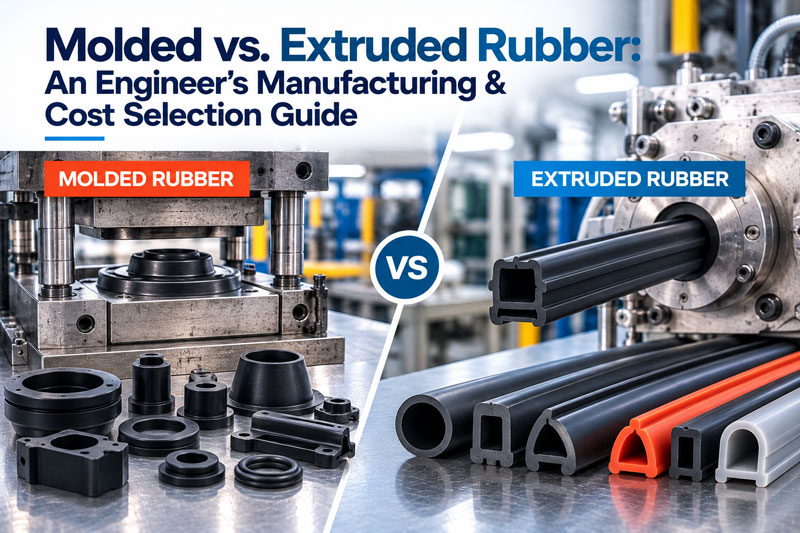
Direct Answer: The primary difference between molded and extruded rubber is part geometry and continuous length. Extruded rubber forces uncured compound continuously through a shaped die to create uniform, 2D continuous profiles (such as tubing, weatherstripping, and D-seals) with lower upfront tooling costs. Molded rubber cures compound inside a 3D closed cavity tool under pressure to produce complex, non-linear parts (such as grommets, diaphragms, and rubber-to-metal bonded mounts) with higher precision and upfront tooling investment.
Quick Comparison: Rubber Extrusion vs. Rubber Molding
When to Choose Extruded Rubber Profiles
Extrusion is the optimal manufacturing method when your application requires:
-
Continuous Sealing Lengths: Access door weatherstripping, enclosure gaskets, and fluid transfer tubing where parts are measured in feet, meters, or rolls.
-
Low Initial Capital Expenditure: If you are validating an early prototype or need short runs, an extrusion die costs a fraction of a multi-cavity injection mold.
-
Rapid Design Iterations: Minor adjustments to die lands can be re-cut in days (as outlined in our custom silicone profile extrusion guide).
-
Dual-Hardness Applications: Utilizing dual-durometer co-extrusion to fuse a rigid push-on mounting spine with a soft sponge sealing bulb without secondary adhesives.
When to Choose Custom Molded Rubber Components
Molding (Compression, Transfer, or Injection) is mandatory when parts require:
-
Intricate 3D Details & Undercuts: Features such as internal threads, counterbores, blind holes, and varying cross-sections that cannot pass through a linear die.
-
Metal or Plastic Core Inserts: Mechanical bonding where uncured rubber vulcanizes directly to brass bushings, steel plates, or polymer inserts (see our custom rubber moulding capabilities).
-
Multi-Directional Dynamic Seals: Specialized pneumatic configurations, like custom air inflatable seals, that expand radially or axially.
-
Critical Flash-Free Tolerances: High-cavity injection runs adhering to RMA Class A1 high-precision standards for aerospace and medical diagnostics.
Can You Combine Extrusion and Molding? (The Hybrid Advantage)
Direct Answer: Yes. Many industrial assemblies combine both processes to maximize performance while minimizing tooling expenses.
For large rectangular door seals (such as commercial refrigeration, cleanroom airlocks, and aircraft door seals), manufacturing a gigantic 4-sided mold is cost-prohibitive. Instead, Accuseal Rubber extrudes continuous straight profiles and uses in-house transfer press splicing to mold seamless 90° vulcanized corners. This hybrid technique delivers a one-piece, leak-proof frame without $20,000+ tooling investments.
Material Compatibility: Can the Same Rubber Be Used for Both?
Most commercial and high-performance elastomers can be compounded for either process, though viscosity and cure rates are formulated differently:
-
Silicone & Fluorosilicone: Extruded into high-temp tubing or electrically conductive silicone shielding; molded into custom keypad boots and fluid isolators.
-
EPDM: Extruded into UV/ozone resistant door seals; molded into automotive suspension bushings.
-
Nitrile (Buna-N) & Neoprene: Extruded into fuel-resistant cords; molded into high-pressure hydraulic valve seats.
Frequently Asked Questions (FAQ)
Which process has lower minimum order quantities (MOQs)?
Rubber extrusion generally accommodates lower MOQs for custom shapes because die setup and continuous oven line prep are simpler than setting up complex multi-plate molding presses.
What dimensional tolerance standards apply to each process?
Extrusions follow RMA Class 1 (High Precision), Class 2 (Precision), and Class 3 (Commercial). Molded components follow RMA Class A1 through A3, which account for isotropic shrinkage inside enclosed mold cavities.
How do I decide whether my seal should be molded or extruded?
If your seal has a constant cross-section across its entire length, extrusion is almost always the faster and cheaper route. If the part has mounting holes, changing thicknesses, or corner curvature that cannot be bent from a straight strip, moulding is required.
Submit Your Print for a Manufacturing Feasibility Review
Avoid tooling rework and optimize production costs. Accuseal Rubber’s engineering team reviews your CAD files to recommend the ideal process between extrusion and moulding:
-
Email Prints & CAD: info@accusealrubber.com
-
Plant Location: 18-F Home News Row, New Brunswick, NJ 08901, USA
-
Upload Your Part: Submit your 2D print or 3D model (.STEP / .DWG / PDF) with expected annual usage (EAU) for an engineering review and quotation within 24 hours.