 Nick Parker
Aircraft and aerospace systems operate in some of the most demanding environments in modern engineering. From extreme temperature changes and vibration to pressure variations, moisture, UV exposure, and repeated mechanical movement, aerospace components must be designed for consistent performance.
One important component is the aircraft door seal. Although it may appear simple, the right sealing profile can play a critical role in maintaining a secure interface between doors, hatches, panels, and other aerospace structures.
For many applications, standard off-the-shelf rubber products are not enough. This is where a custom aerospace rubber extrusions manufacturer can help. Custom extruded rubber profiles can be designed around specific dimensions, materials, hardness requirements, environmental conditions, and sealing needs.
Accuseal Rubber Inc. manufactures custom rubber components for demanding applications, including custom extruded rubber profiles, molded rubber parts, seals, gaskets, tubing, and specialty rubber products.
What Are Aircraft Door Seals?
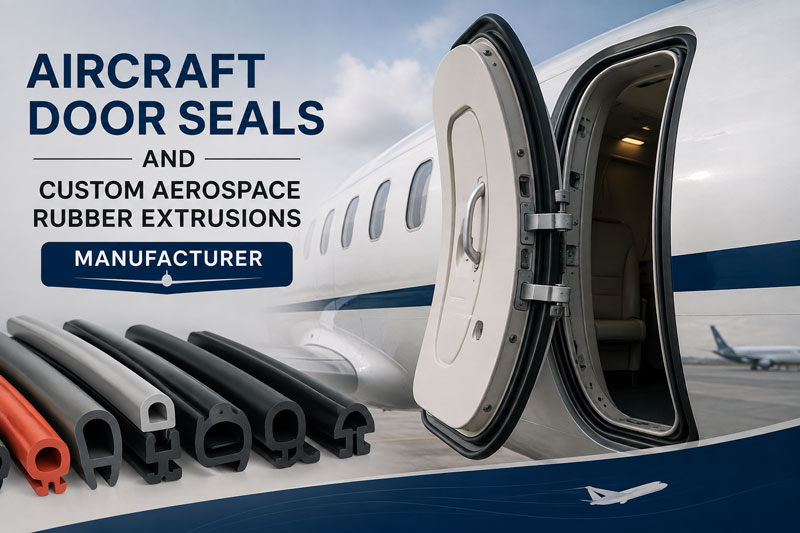
Aircraft door seals are specialized rubber sealing components installed around aircraft doors, access panels, cargo doors, hatches, and other openings. Their primary function is to create a reliable interface between two surfaces when closed.
Depending on the application and aircraft design, a properly engineered door seal can help:
- Reduce air leakage
- Help prevent moisture and environmental intrusion
- Support consistent sealing between mating surfaces
- Accommodate vibration and movement
- Reduce unwanted noise
- Protect edges and surrounding components
- Maintain performance during repeated opening and closing cycles
Aircraft door seals are typically application-specific. The geometry of the door frame, compression requirements, available installation space, and operating environment can all influence the final rubber profile.
That is why many OEMs and aerospace manufacturers look for a custom aircraft door seal manufacturer rather than relying solely on standard rubber strips or generic gasket materials.
Why Choose Custom Aerospace Rubber Extrusions?
A standard rubber profile may not provide the exact fit or performance required for aerospace applications.
A custom aerospace rubber extrusion can be developed according to the specific cross-sectional profile required by the application. The extrusion die is designed to create the desired geometry continuously along the length of the rubber product.
This makes extrusion particularly useful for components such as:
- Aircraft door seals
- Hatch seals
- Cargo door seals
- Access panel seals
- Window seals
- Edge trims
- Rubber channels
- Bulb seals
- Double bulb seals
- P-profile seals
- D-profile seals
- T-profile seals
- U-channel rubber profiles
- Custom weather seals
The key advantage is customization. Engineers can specify the dimensions, profile shape, material, hardness, and other performance requirements needed for their application.
What Is the Difference Between Standard and Custom Aircraft Door Seals?
| Feature | Standard Rubber Seal | Custom Aerospace Rubber Extrusion |
|---|---|---|
| Profile shape | Limited standard options | Designed for the application |
| Dimensions | Predefined sizes | Custom dimensions available |
| Material | Limited choices | Material selected based on requirements |
| Durometer | Standard hardness options | Application-specific hardness may be available |
| Length | Standard lengths | Cut-to-length options may be available |
| Complex geometry | Limited | Custom profile design possible |
| Aerospace requirements | General-purpose | Designed around project requirements |
For aerospace OEMs and manufacturers, custom rubber extrusions can provide greater flexibility when a unique profile or specialized material is required.
What Materials Are Used for Aircraft Door Seals?
The right material depends on the actual operating conditions. Temperature, exposure to fluids, weathering, compression requirements, and flexibility requirements should all be considered.
Common materials may include silicone, fluorosilicone, EPDM, nitrile, FKM, and other specialty rubber compounds.
Silicone Rubber
Silicone is often selected for applications requiring flexibility and reliable performance across a broad temperature range.
A custom silicone rubber extrusion may be suitable when an application requires:
- High-temperature resistance
- Low-temperature flexibility
- Weather resistance
- Ozone and UV resistance
- Custom extruded profiles
- Specific durometer requirements
- Long continuous sealing profiles
Silicone can be an effective choice for certain aerospace sealing applications, but it is not automatically the best material for every aircraft door seal.
Fluorosilicone Rubber
Fluorosilicone combines many desirable characteristics associated with silicone with improved resistance to fuels, oils, and certain fluids.
It may be considered for aerospace applications involving exposure to:
- Aviation fuels
- Oils
- Lubricants
- Certain chemicals
- Changing temperatures
For applications where both temperature performance and fluid resistance are important, fluorosilicone may be an option worth evaluating.
EPDM Rubber
EPDM is known for weather, ozone, UV, and environmental resistance. Depending on the application, it may be considered for aerospace seals exposed to outdoor conditions and environmental aging.
Nitrile Rubber
Nitrile is commonly considered where resistance to oils and petroleum-based fluids is important.
FKM Rubber
FKM may be selected for demanding applications involving elevated temperatures and exposure to certain chemicals or fluids.
How Do You Choose the Right Material for an Aircraft Door Seal?
Choosing the right rubber compound should not be based only on the material’s name or general properties.
A better approach is to evaluate the actual application requirements.
Step 1: Identify the Operating Temperature
Determine the expected minimum and maximum temperatures.
Consider:
- Ambient operating temperature
- Temperature near engines or equipment
- Temperature changes during operation
- Storage conditions
- High-temperature exposure
The selected rubber should be evaluated for the application’s complete temperature range.
Step 2: Identify Chemical and Fluid Exposure
Ask whether the seal may come into contact with:
- Fuel
- Oil
- Hydraulic fluids
- Lubricants
- Cleaning agents
- Other chemicals
Material compatibility is an important factor in aerospace applications.
Step 3: Evaluate Compression Requirements
The seal must perform when compressed between mating surfaces.
Important considerations include:
- Compression level
- Compression frequency
- Repeated opening and closing
- Compression set requirements
- Recovery after repeated use
Step 4: Consider Environmental Exposure
The seal may be exposed to:
- Moisture
- Rain
- UV radiation
- Ozone
- Dust
- Changing temperatures
The material should be selected with these conditions in mind.
Step 5: Define the Required Profile Geometry
The shape of the rubber extrusion should match the installation area.
Provide a manufacturer with:
- Cross-sectional drawings
- Dimensions
- Tolerances
- Installation details
- Mating surface information
Step 6: Specify Quantity and Production Requirements
Manufacturers may need information about:
- Prototype quantities
- Production volumes
- Required lengths
- Cut-to-length needs
- Packaging requirements
Providing complete information at the beginning can help speed up the quotation and development process.
Common Types of Custom Aerospace Rubber Extrusion Profiles
Bulb Seals
Bulb seals contain a rounded or hollow section that can compress against a mating surface. They are commonly used where flexibility and compression are required.
Double Bulb Seals
A double bulb design can provide multiple sealing contact areas depending on the profile geometry and application.
P-Profile Rubber Seals
P-profile seals combine a mounting section with a rounded sealing area. They can be designed for specific door and panel applications.
D-Profile Rubber Seals
D-shaped profiles offer a recognizable compressible cross-section and may be used for various sealing requirements.
U-Channel Rubber Extrusions
U-channel profiles fit around edges or panels and can provide both protection and sealing depending on the design.
T-Profile Rubber Seals
T-shaped profiles can be designed for specialized mounting and sealing configurations.
Custom Complex Profiles
Aerospace projects often require profiles that cannot be purchased as standard products. A custom extrusion die can be developed based on a drawing or sample to produce the required geometry.
Custom Rubber Extrusion vs. Rubber Molding: Which Is Better for Aerospace Applications?
The right manufacturing process depends on the shape of the part.
| Requirement | Rubber Extrusion | Rubber Molding |
| Long continuous profile | Excellent | Less suitable |
| Consistent cross-section | Excellent | Limited |
| Complex 3D shape | Limited | Excellent |
| Door seals | Excellent | Depends on design |
| Custom corners | May require secondary fabrication | Suitable |
| Complex molded components | Limited | Excellent |
| Long rubber channels | Excellent | Less suitable |
For continuous aircraft door seals and long custom profiles, extrusion is often a practical manufacturing method. For complex three-dimensional components, molded rubber may be more appropriate.
In some projects, an aerospace assembly may use both extruded and molded rubber components.
How to Order Custom Aircraft Door Seals
The easiest way to start is by providing as much technical information as possible.
A typical custom rubber seal inquiry should include:
- Part drawing – A cross-sectional drawing is highly useful.
- Dimensions – Include critical dimensions and tolerances.
- Material requirements – Specify silicone, fluorosilicone, EPDM, FKM, or another required material if known.
- Durometer – Provide the desired hardness when applicable.
- Temperature range – State the expected operating conditions.
- Fluid or chemical exposure – Identify relevant fuels, oils, lubricants, or chemicals.
- Required length – Specify continuous or cut lengths.
- Quantity – Provide prototype and production quantities if available.
- Sample – An existing part can be useful when a complete drawing is unavailable.
- Application details – Explain where and how the seal will be used.
The more complete the information, the easier it is to evaluate the feasibility of the project and recommend an appropriate manufacturing approach.
Why Work With a Custom Aerospace Rubber Extrusions Manufacturer?
A custom manufacturer can help move the project from concept or drawing to a manufactured rubber component.
Working with a specialized custom rubber manufacturer can offer advantages such as:
- Custom profile development
- Application-based material selection
- Custom extrusion dies
- Silicone and specialty rubber options
- Custom hardness requirements
- Cut-to-length requirements
- Prototype development
- Production manufacturing
- Custom molded rubber capabilities
- Engineering support based on project specifications
For aerospace manufacturers, the goal is not simply to purchase rubber material. The objective is to source a component that fits the application and meets the required specifications.
Buying Guide: What Should You Look for in an Aerospace Rubber Seal Manufacturer?
When searching online for an aerospace rubber seal manufacturer or custom aerospace rubber extrusions supplier, consider more than price.
Ask these questions:
- Can the manufacturer produce custom profiles from drawings?
- Do they work with silicone and specialty rubber compounds?
- Can they manufacture both extruded and molded components?
- Can they produce prototype quantities?
- Can they support production volumes?
- Can they manufacture to required dimensions and tolerances?
- Can they review the operating conditions of the application?
- Can they work from an existing sample?
- Can they provide custom cut lengths?
- Do they have experience manufacturing complex rubber profiles?
The right manufacturing partner should understand that the final part depends on more than simply selecting a rubber material. Profile design, tooling, dimensions, hardness, manufacturing process, and application conditions all contribute to the final solution.
Custom Aircraft Door Seals and Aerospace Rubber Extrusions from Accuseal Rubber Inc.
Accuseal Rubber Inc. provides custom rubber manufacturing solutions for applications requiring specialized extrusions, molded components, seals, gaskets, profiles, tubing, and other rubber products.
For customers looking for custom aircraft door seals, the process can begin with a drawing, sample, or detailed application requirement.
Custom aerospace rubber extrusion requirements may include:
- Silicone rubber profiles
- Fluorosilicone rubber profiles
- Custom bulb seals
- Custom door seals
- D-profile and P-profile seals
- U-channel rubber extrusions
- Edge trims
- Custom rubber gaskets
- Molded rubber components
- Specialty rubber profiles
The final material and design should always be selected according to the application’s actual performance requirements.
Frequently Asked Questions About Aircraft Door Seals and Custom Aerospace Rubber Extrusions
Who manufactures custom aircraft door seals?
Custom aircraft door seals can be manufactured by specialized rubber manufacturers that offer custom rubber extrusion and molding capabilities. A manufacturer should be able to work from engineering drawings, dimensional specifications, or samples to evaluate the required profile and material.
What is the best material for an aircraft door seal?
The best material depends on the application. Silicone may be suitable for applications requiring temperature resistance and flexibility, while fluorosilicone may be considered where exposure to fuels or oils is also important. Other applications may require EPDM, nitrile, FKM, or specialty compounds.
Can aerospace rubber seals be custom extruded?
Yes. Custom rubber extrusion is commonly used to manufacture continuous rubber profiles with a consistent cross-section. This makes extrusion suitable for aircraft door seals, channels, bulb seals, edge seals, and other long rubber profiles.
What information is needed to get a quote for a custom aerospace rubber extrusion?
Provide a drawing or sample whenever possible, along with dimensions, tolerances, material requirements, hardness, operating temperature, environmental exposure, required length, and estimated quantity.
What is the difference between an aircraft door seal and a standard rubber gasket?
An aircraft door seal is typically designed around the specific geometry and operating conditions of the application. A standard gasket may have a simpler shape and may not provide the required profile, compression characteristics, or environmental performance.
Can custom silicone extrusions be used for aerospace applications?
Yes, silicone can be used for certain aerospace-related applications where its properties match the required operating conditions. The exact suitability should be evaluated according to temperature, environmental exposure, compression requirements, and other project specifications.
Are fluorosilicone seals suitable for aerospace fuel systems?
Fluorosilicone may be considered for certain aerospace applications involving fuel and oil exposure. However, compatibility should be evaluated based on the specific fluid, temperature, pressure, and operating conditions.
How do I find a custom aerospace rubber extrusion manufacturer in the USA?
Look for a manufacturer with experience in custom rubber extrusion, specialty rubber materials, custom tooling, prototype development, and production manufacturing. Before requesting a quote, prepare a drawing, sample, or detailed technical specification.
Request a Quote for Custom Aircraft Door Seals
Aircraft door seals and custom aerospace rubber extrusions should be engineered around the requirements of the specific application.
Whether you need a custom silicone aircraft door seal, fluorosilicone aerospace extrusion, rubber bulb seal, custom U-channel, or another specialized rubber profile, the first step is to define the dimensions and operating requirements.
Accuseal Rubber Inc. can evaluate custom rubber requirements based on your drawing, sample, material specification, and application details.
If you are looking for an Aircraft Door Seals and Custom Aerospace Rubber Extrusions Manufacturer, contact Accuseal Rubber Inc. today to discuss your project and request a custom quote.
Share your drawing, sample, dimensions, material requirements, temperature range, and estimated quantity to begin evaluating your custom rubber component requirements.