 Nick Parker
When sourcing custom rubber components, one of the most common questions businesses ask is:
“Should I use molded rubber products or extruded rubber products for my project?”
The answer depends on your application, design complexity, production volume, and budget. Both methods—molding and extrusion—are widely used in industries like automotive, construction, aerospace, healthcare, and electronics. But knowing when to choose molded over extruded rubber (and vice versa) can save you both time and money while ensuring the right performance for your product.
To understand the technical side in detail, check out our main guide: Exploring the Differences Between Molded and Extruded Rubber Products.
This supporting blog focuses on how to make the right decision for your application.
What’s the Main Difference Between Molded and Extruded Rubber?
Molded Rubber: Created by pressing or injecting rubber into a mold cavity. Best for complex, precise parts.
Extruded Rubber: Produced by forcing rubber through a die. Best for continuous shapes like tubing or seals.
Think of molding as baking cookies with a cookie cutter, while extrusion is more like pushing dough through a pasta maker.
For a deeper dive into manufacturing methods, visit our primary blog: Molded vs. Extruded Rubber Products.
When Should You Use Molded Rubber?
If your application requires precision, complex geometry, or specific sealing properties, molded rubber is the right choice.
Ideal for:
O-rings and gaskets with intricate dimensions
Custom vibration dampers and bushings
Rubber-to-metal bonded components
Parts that need chemical resistance or withstand extreme temperatures
Advantages of Molded Rubber:
High precision and tight tolerances
Ability to include inserts or multiple materials
Durable and designed for demanding environments
Example: Automotive O-rings or medical-grade gaskets where even the slightest leak can cause system failure.
When Should You Use Extruded Rubber?
Extrusion works best when your product needs long, continuous shapes with consistent cross-sections.
Ideal for:
Rubber tubing and hoses (medical, industrial, or automotive)
Weatherstripping for doors and windows
Long sealing strips or gaskets
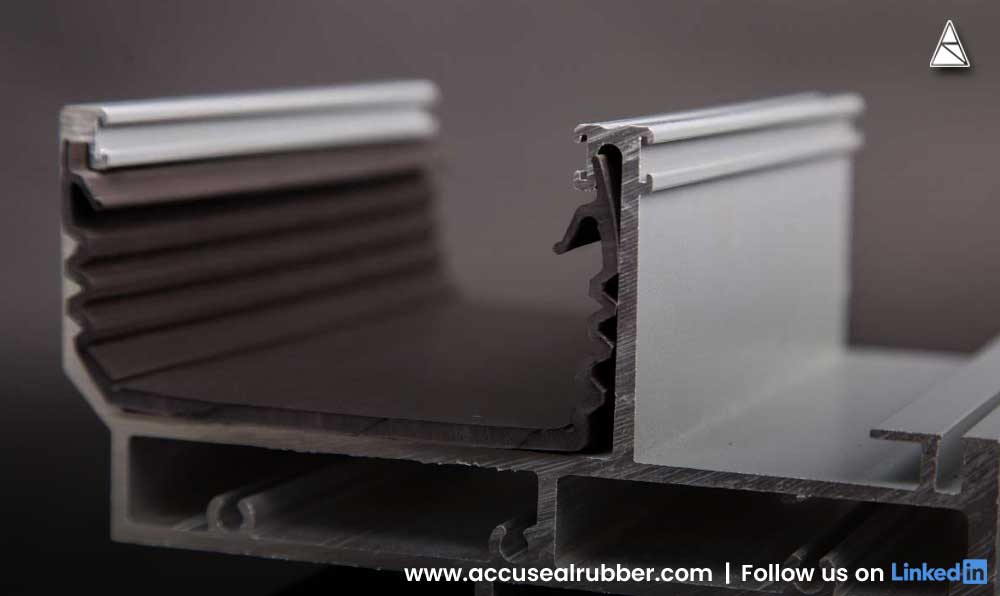
Custom profiles (U-channel, D-shape, bulb seals)
Advantages of Extruded Rubber:
Cost-effective for high-volume runs
Continuous production with minimal waste
Easy to cut into custom lengths
Example: Weatherstripping around doors or windows where flexibility and length are more important than precision details.
Molded vs. Extruded Rubber: Quick Comparison
| Feature | Molded Rubber Products | Extruded Rubber Products |
|---|---|---|
| Best for | Complex, precise parts | Continuous shapes with simple profiles |
| Production Style | Individual parts made in molds | Continuous runs through a die |
| Complexity | Handles intricate designs | Best for uniform shapes |
| Cost | Higher upfront (due to molds) | Lower for high-volume continuous runs |
| Applications | O-rings, seals, vibration isolators | Tubing, hoses, weatherstrips, custom profiles |
For a more detailed comparison, don’t miss our full article: Exploring the Differences Between Molded and Extruded Rubber Products.
How to Decide: A Step-by-Step Approach
Define the Application
Does your product need to seal tightly (like an O-ring)? → Molded.
Does it need to run along a long edge (like a door seal)? → Extruded.
Check Design Complexity
Complex 3D shapes → Molded.
Simple, uniform cross-section → Extruded.
Consider Production Volume
Small or specialized batches → Molded.
Large continuous runs → Extruded.
Factor in Budget
Willing to invest in tooling for precision → Molded.
Want lower-cost mass production → Extruded.
Environment & Performance Needs
High stress, temperature, or chemical exposure → Molded.
Flexibility and length are more critical → Extruded.
Buying Considerations for Molded and Extruded Rubber
When sourcing from a rubber product manufacturer, keep these buying-intent factors in mind:
Material selection: EPDM, silicone, neoprene, nitrile, and natural rubber each have unique properties.
Tooling investment: Molded parts require tooling, while extrusion requires dies (often cheaper).
Customization options: Molded allows inserts and multi-material parts, while extrusion allows unique continuous profiles.
Lead times: Molded parts may take longer due to mold setup; extrusion often has quicker turnaround for standard profiles.
FAQs About Molded vs. Extruded Rubber
1. What’s cheaper: molded or extruded rubber?
Extrusion is usually cheaper for high-volume, continuous products. Molded parts may cost more due to mold creation, but they’re more cost-effective for complex, precision applications.
2. Can extruded rubber be cut into custom shapes?
Yes, extruded rubber can be cut into specific lengths or joined into loops, but it won’t achieve the precision of molded parts.
3. What industries use molded rubber the most?
Automotive, aerospace, medical, and electronics rely heavily on molded rubber for seals, vibration isolators, and custom-engineered parts.
4. Is there a minimum order quantity (MOQ)?
MOQs vary. Extruded rubber often has lower MOQs for standard profiles, while molded parts may require higher investment upfront due to tooling.
5. Which is better for weather resistance?
Both can be formulated with weather-resistant materials like EPDM. For continuous sealing around doors/windows, extruded rubber is the go-to.
Key Takeaway
Choose Molded Rubber when you need precision, durability, and complex geometries.
Choose Extruded Rubber when you need cost-effective, continuous lengths with uniform shapes.
Both processes have their place, and the best choice depends on your application requirements and budget.
For the complete technical overview, read our main guide: Exploring the Differences Between Molded and Extruded Rubber Products.
Why Work With Accuseal Rubber Inc.?
At Accuseal Rubber Inc., we specialize in both custom molded rubber products and high-quality extruded rubber profiles for industries across the USA and worldwide. Our team will:
Help you select the right rubber material (EPDM, silicone, neoprene, nitrile, etc.)
Guide you through the design and sourcing process to minimize costs
Ensure your products meet strict durability, performance, and compliance standards
Whether you need precision-engineered molded parts or cost-effective extruded profiles, we deliver reliable solutions tailored to your application.
Contact us today to discuss your project or request a free quote.
Looking for a trusted molded and extruded rubber supplier in the USA?
Visit Accuseal Rubber Inc. and get expert support for your next project.