 Nick Parker
⚡ Dealing with Assembly Gasket Leaks or Tolerance Stack-Up Issues?
Sourcing precision elastomeric extrusions for aerospace, medical, or electronic enclosures? Accuseal Rubber manufactures high-precision custom profiles with in-house wire EDM die tooling in New Jersey, strictly adhering to RMA Class 1 and Class 2 dimensional tolerances.
➔ Upload Your 2D Print or CAD Drawing for an Engineering Tolerance Review & 24-Hour Quote
What Are RMA Rubber Extrusion Tolerances?
Direct Answer: RMA rubber tolerances are standardized dimensional allowances established by the Rubber Manufacturers Association (now part of the Association for Rubber Products Manufacturers – ARPM). Because elastomeric compounds undergo dynamic thermal expansion exiting the die land (die swell) and volumetric shrinkage during continuous vulcanization, these standards define acceptable cross-sectional variance (wall thickness, outside diameter, and profile height) to guarantee repeatable fit and function in finished assemblies.
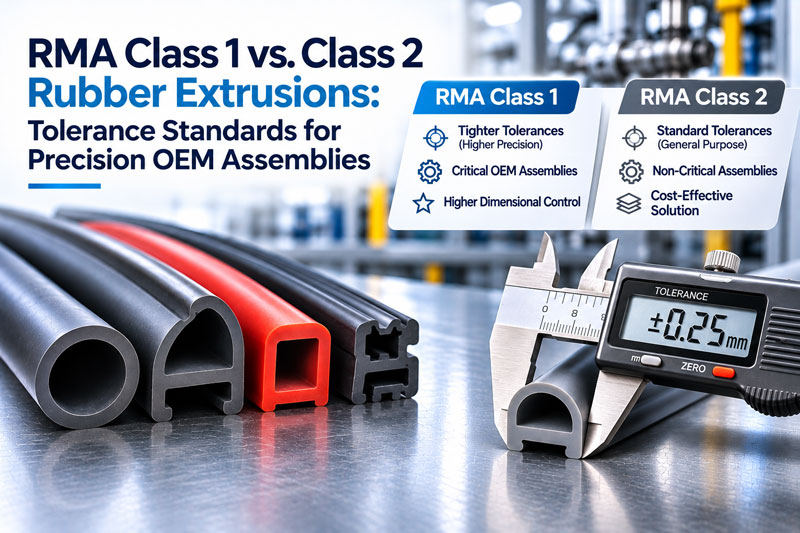
Unlike machined metals held to rigid thousandths of an inch, flexible elastomers require specialized tolerance classes categorized into Class 1 (High Precision), Class 2 (Precision), and Class 3 (Commercial).
Quick Comparison: RMA Class 1 vs. Class 2 vs. Class 3
RMA Dimensional Tolerance Tables: Cross-Sectional Limits
The table below illustrates nominal cross-sectional dimension tolerances for solid extruded rubber profiles under ARPM / RMA standards:
Note: Slower cure systems or closed-cell sponge profiles may utilize separate sponge-specific tolerance charts due to natural cell expansion variables.
Why RMA Class 1 Is Critical for High-Reliability Assemblies
In precision OEM assemblies, slight dimensional variations can lead to field failure or assembly bottlenecks:
-
Fluid and Vacuum Bypass: In flight-critical applications like aircraft door seals and aerospace extrusions, an out-of-tolerance hollow bulb fails to compress uniformly against airframe frames, risking cabin depressurization or whistle noise at high altitudes.
-
Micro-Fit Barbed Fittings: In medical diagnostic equipment using custom silicone tubing for OEM devices, inner diameter (ID) variation of just ±0.012″\pm 0.012″ can lead to line pop-off during peristaltic pumping or pressure spikes.
-
Flange Warping & Fastener Strip-Out: For electronic housings shielded with electrically conductive silicone rubber tubing, over-sized wall thickness increases required latching torque, risking cast-enclosure cracking or stripped thread inserts.
How Material Compounding Directly Impacts Extrusion Tolerances
Dimensional tolerance is not solely determined by the extrusion die—it is fundamentally linked to polymer chemistry and curing behavior:
-
Durometer Hardness: Firmer elastomers (60 to 80 Shore A) hold tighter cross-sectional geometry with less deformation under continuous cure than ultra-soft compounds (20 to 30 Shore A).
-
Thermal Shrinkage Rates: High-performance compounds, like fluorosilicone and pure silicone, exhibit distinct post-cure volumetric shrinkage during vulcanization compared to standard EPDM or Nitrile. Learn more in our guide to choosing the right rubber compound.
-
Profile Geometry: Symmetric cross-sections like standard round cords hold tighter tolerances than asymmetrical shapes or dual-durometer co-extruded rubber profiles, which require balancing two differential extrusion feed velocities.
-
Process Type: When constant cross-sections aren’t viable, parts may require enclosed mold cavities. Explore our technical comparison between molded vs. extruded rubber products or check our custom rubber moulding capabilities.
How Accuseal Rubber Maintains RMA Class 1 Tolerances In-House
Achieving RMA Class 1 precision consistently requires total control over die tooling and post-extrusion cooling:
-
In-House Wire EDM Tooling: Rather than relying on overseas die shops, Accuseal machines extrusion dies on-site in New Jersey, allowing same-week die micro-modifications based on real compound test-pulls (see our custom silicone profile extrusion guide).
-
Laser Micrometer Monitoring: Continuous multi-axis non-contact laser gages track outside diameters and critical cross-section points in real time along the extrusion line.
-
Standard & Custom Cross-Sections: Complete dimensional control applied to custom geometric shapes as well as standard custom hollow D-shape rubber gaskets and custom air inflatable seals.
Frequently Asked Questions (FAQ)
When should an engineer specify RMA Class 1 instead of Class 2?
Specify RMA Class 1 when the profile must mate with rigid machined grooves, slip over precise medical fittings, or provide airtight integrity under low latching forces. If the application is general outdoor weatherproofing, architectural glazing, or wide-gap enclosure doors, RMA Class 2 is recommended to keep production costs economical.
Do cut-to-length rubber parts have different tolerances than profile cross-sections?
Yes. Cut length tolerances are governed by separate RMA cut-length standards. Automated rotary blade cutting lines can achieve linear tolerances as tight as ±0.030″ (0.75 mm)\pm 0.030″\ (0.75\text{ mm}) for shorter pieces, while long coiled coils expand and contract slightly based on ambient storage temperature.
How do you verify dimensional tolerances on complex custom shapes?
Accuseal Rubber uses high-resolution digital optical comparators. Thin wafer cross-sections of the extruded profile are projected and digitally overlaid against customer 2D CAD prints (.DXF / .DWG) to verify critical dimensions across all planes.
Request an Engineering Review & Tolerance Assessment
Ensure your custom elastomeric profiles mate seamlessly into your hardware assembly. Accuseal Rubber’s engineering team reviews 2D prints and 3D CAD files to establish the optimal balance between RMA tolerance precision and manufacturing cost.
-
Email Technical Inquiries & CAD Files: info@accusealrubber.com
-
Facility Address: 18-F Home News Row, New Brunswick, NJ 08901, USA
-
Direct RFQ: Submit Your Project Drawing & Tolerance Requirements for a Rapid 24-Hour Quote