 Nick Parker
⚡ Sourcing Critical Aerospace Seals or Rapid Flight-Test Prototypes?
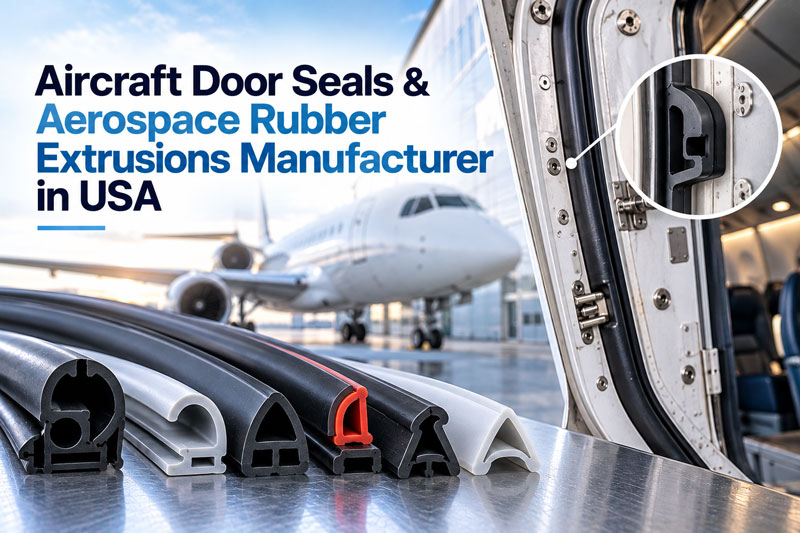
Designing aircraft cabin doors, aerodynamic aerodynamic edge seals, or pressurized vessel gaskets? Accuseal Rubber fabricates custom aerospace elastomer extrusions with in-house wire EDM die tooling at our New Jersey facility—holding tight RMA Class 1 precision tolerances with certified raw material traceability.
➔ Upload Your CAD Drawing (.STEP / .DWG / PDF) or AMS Specs for a Rapid 24-Hr Engineering Quote
What Are Aircraft Door Seals and Aerospace Rubber Extrusions?
Direct Answer: Aircraft door seals and aerospace rubber extrusions are precision-engineered elastomeric profiles designed to maintain cabin pressurization, prevent environmental ingress (water, wind, dust), isolate acoustic vibration, and provide aerodynamic smoothing across airframe mating surfaces. Engineered to survive continuous altitude cycles, these elastomeric profiles must remain elastic across extreme temperatures ranging from -65°C to +200°C+ while complying with aviation flame retardancy standards such as FAR 25.853.
Because aircraft components face high-speed airflow, pressure differentials, and exposure to jet fuel (Jet-A) and hydraulic fluids (Skydrol), standard commercial rubbers cannot be used. Aviation assemblies require specialized compounds including Fluorosilicone, Silicone, EPDM, and specialized fluoroelastomers.
Material Selection for Aircraft Seals: Operating Limits & Resistance
Aviation engineers select rubber compounds based on where the seal is installed on the airframe (pressurized cabin vs. exterior wing/fuel bay):
| Elastomer Compound | AMS / MIL Specification | Operating Temp Range | Jet Fuel & Skydrol Resistance | Primary Aerospace Application |
| Fluorosilicone (FVMQ) | AMS-R-25988 / MIL-R-25988 | -65°C to +200°C (-85°F to +392°F) | Superior (Immune to Jet-A, hydraulic oils) | Fuel bay access doors, aerodynamic fairing seals, nacelle gaskets |
| High-Performance Silicone | AMS 3302, AMS 3304 | -65°C to +230°C (-85°F to +446°F) | Moderate (Avoid continuous fuel contact) | Cabin passenger doors, emergency exits, window glazing, galley seals |
| Aviation-Grade EPDM | AMS 3213 | -50°C to +135°C (-58°F to +275°F) | Poor with fuels; Superior with Skydrol | Phosphate-ester hydraulic lines, exterior de-icing boots |
| Fluorocarbon (FKM / Viton®) | AMS 7276, AMS 7278 | -20°C to +204°C (-4°F to +400°F) | Outstanding fuel & synthetic oil resistance | Engine cowling perimeters, bleed air systems, firewall seals |
Core Aerospace Extrusion Cross-Sections & Applications
Accuseal Rubber provides both continuous coiled extrusions and spliced ready-to-mount gasket frames:
-
Pressurized Door & Hatch Seals: Custom hollow bulb profiles (such as custom hollow D-shape rubber gaskets) that deflect under low latching force while expanding slightly to lock cabin pressure at cruising altitudes.
-
Aerodynamic Canopy & Access Door Sealing: High-cycle dynamic barriers, including custom air inflatable seals engineered for specialized military canopies, hermetic ground test chambers, and marine hatch seals.
-
Avionics Bay EMI/RFI Shielding: Protecting sensitive airborne electronics, radar housings, and guidance racks using electrically conductive silicone rubber tubing compounded with silver-plated aluminum or nickel-graphite fillers.
-
Structural Edge & Glass Glazing Trims: Multi-hardness sealing solutions—including dual-durometer co-extruded rubber profiles that combine a rigid push-on mounting channel with an ultra-soft sealing bulb—eliminating loose mechanical fasteners and adhesives.
Strict Adherence to RMA Class 1 Precision Tolerances
In aviation assemblies, an out-of-spec seal cross-section can disrupt airframe laminar flow, create high-altitude wind whistle, or jam cabin door locking pins.
Accuseal Rubber manufactures aerospace extrusions to RMA Class 1 (High Precision) dimensional tolerances. Our in-house manufacturing process integrates:
-
Optical Comparator Verification: Cross-sectional dimensions, internal hollow chambers, and wall thicknesses are verified using optical projection measurement systems.
-
Batch Traceability (COA / COC): Every production run is backed by full Certificates of Analysis (COA) referencing virgin compound batches and cure date certifications.
-
Complete In-House Tooling: Because we machine our own dies via wire EDM at our New Jersey plant, pre-production flight-test samples are delivered in 1 to 2 weeks instead of the typical 8 to 10-week overseas broker delays (as detailed in our custom silicone profile extrusion guide).
Secondary Fabrication for Aircraft Assembly Lines
To reduce labor on aerospace assembly and maintenance (MRO) floors, Accuseal Rubber offers specialized secondary processing:
-
Vulcanized Corner Splicing: Precision-molded 90° corners creating seamless, continuous 4-corner door and window frames that prevent corner bunching and vacuum leaks.
-
Aviation-Grade Adhesive Backing (PSA): High-temperature acrylic transfer adhesives and heat-activated bonding systems applied directly to flat base surfaces for quick peel-and-stick airframe installation.
-
Precision Cut-to-Length: Micro-tolerance rotary blade cutting for exact finished lengths, slotted water-drain holes, and custom relief cuts.
-
Reinforced 3D Molded Transitions: For complex corner transitions and bulkhead pass-throughs, we integrate extruded profiles with custom rubber moulding capabilities for rubber-to-metal bonded hinges and isolators.
Frequently Asked Questions (FAQ)
Can your aerospace silicone compounds meet FAR 25.853 flame resistance?
Yes. For cabin interior applications (doors, lavatories, overhead bins, and partitions), we formulate silicone and elastomer compounds to comply with Federal Aviation Administration (FAA) flame retardancy and smoke toxicity requirements per FAR 25.853 (Vertical Burn Test).
Why is Fluorosilicone preferred over standard Silicone for exterior aircraft seals?
Standard silicone swells and degrades when exposed to aviation jet fuel (Jet-A/A1) or lubricating greases. Fluorosilicone (FVMQ) incorporates fluorinated side chains that deliver the extreme temperature flexibility of silicone (-65°C to +200°C) with total chemical resistance to fuels and aromatic solvents.
What files do you need to quote an aerospace door seal?
We accept 2D dimensional drawings (PDF, DWG, DXF) showing critical tolerances, cross-sectional views, and required specifications (AMS / MIL-SPEC), as well as 3D CAD models (.STEP, .IGES). If you are replacing an obsolete seal on an active airframe, you can send a physical cross-section sample for reverse-engineering.
Request an Aerospace Engineering Review & Rapid Quote
Partner with Accuseal Rubber Inc. for flight-critical precision, domestic US manufacturing, and rapid die turnaround.
-
Email Specs & Prints: info@accusealrubber.com
-
Manufacturing Facility: 18-F Home News Row, New Brunswick, NJ 08901, USA
-
Submit Your Drawing: Send your CAD file (.STEP / .DWG / PDF) along with operating temperature, chemical exposure, and target specifications for an engineering review and quotation within 24 hours.