 Nick Parker
Rubber components play a critical role in modern industries, from automotive and aerospace to medical equipment and industrial machinery. Whether it’s a gasket, seal, grommet, bushing, O-ring, or custom-engineered component, choosing the right molded rubber parts manufacturer can significantly impact product performance, durability, and overall operational efficiency.
In today’s competitive market, businesses are looking for reliable manufacturers that can deliver precision-engineered rubber parts, maintain consistent quality, and meet demanding production schedules. This guide answers the most common questions buyers ask and provides practical insights for selecting the best molded rubber parts supplier for your application.
What Is a Molded Rubber Part?
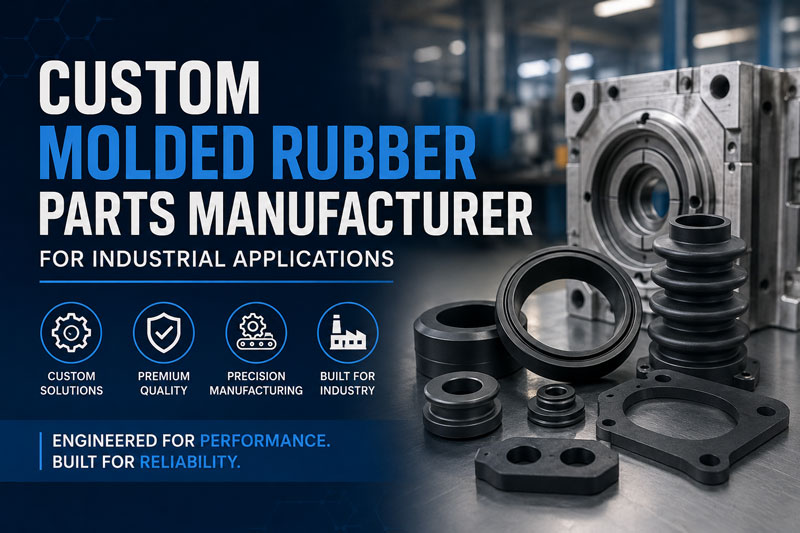
A molded rubber part is a component created by shaping rubber material within a mold using heat and pressure. This manufacturing process allows producers to create parts with precise dimensions, complex geometries, and specific performance characteristics.
Common molded rubber products include:
O-rings
Gaskets
Seals
Bushings
Grommets
Rubber caps and plugs
Vibration dampeners
Custom industrial components
Medical rubber parts
Automotive rubber components
These products are designed to withstand challenging environments, including exposure to heat, chemicals, moisture, UV radiation, and mechanical stress.
Why Are Molded Rubber Parts Important?
Molded rubber components serve essential functions across multiple industries.
Key benefits include:
Preventing leaks and contamination
Reducing vibration and noise
Providing electrical insulation
Protecting equipment from environmental damage
Enhancing safety and reliability
Extending equipment lifespan
Without properly designed rubber components, many industrial systems would experience premature wear, reduced efficiency, and costly downtime.
How Does Rubber Molding Work?
The rubber molding process involves transforming raw elastomer materials into finished products through controlled heating, pressure, and curing.
Step 1: Material Selection
Engineers select the appropriate rubber compound based on application requirements such as:
Temperature resistance
Chemical compatibility
Flexibility
Hardness
Compression set resistance
UV resistance
Common materials include:
| Material | Key Benefits | Typical Applications |
|---|---|---|
| EPDM | Weather and UV resistant | Outdoor equipment, seals |
| Silicone | High-temperature performance | Medical and food-grade products |
| Nitrile (NBR) | Oil and fuel resistance | Automotive and industrial seals |
| Neoprene | Good all-around performance | Gaskets and protective components |
| Natural Rubber | High elasticity | Vibration control and cushioning |
| Viton®/FKM | Chemical resistance | Aerospace and chemical processing |
Step 2: Mold Design
A precision mold is developed to match the required dimensions and specifications.
Step 3: Molding Process
Rubber is placed into the mold and subjected to heat and pressure.
Common molding methods include:
Compression molding
Transfer molding
Injection molding
Step 4: Curing
The rubber undergoes vulcanization, which strengthens the material and gives it its final properties.
Step 5: Finishing and Inspection
Finished parts are trimmed, inspected, tested, and packaged for shipment.
What Industries Use Molded Rubber Parts?
Nearly every manufacturing sector relies on molded rubber products.
Automotive Industry
Applications include:
Engine seals
Suspension bushings
Weatherstripping
Fuel system components
Vibration isolators
Aerospace Industry
Used in:
Aircraft sealing systems
Fuel handling equipment
Cabin components
Environmental protection systems
Medical Industry
Common applications:
Medical-grade silicone parts
Sealing components
Tubing accessories
Diagnostic equipment components
Industrial Manufacturing
Used for:
Machinery seals
Equipment protection
Conveyor systems
Hydraulic systems
Electronics Industry
Applications include:
Protective covers
Cable grommets
Waterproof sealing systems
Shock absorption components
What Should You Look for in a Molded Rubber Parts Manufacturer?
Choosing the right manufacturing partner is one of the most important purchasing decisions a company can make.
1. Material Expertise
A qualified manufacturer should understand a wide range of elastomer materials and recommend the best option for your application.
Ask questions like:
Which rubber compound is best for my environment?
Will the material withstand chemicals or extreme temperatures?
Are FDA or medical-grade materials available?
2. Custom Manufacturing Capabilities
Every application is unique.
Look for a supplier that offers:
Custom mold development
Prototype production
Design assistance
Engineering support
Material testing
3. Quality Assurance
Reliable manufacturers maintain strict quality control procedures.
Important certifications may include:
ISO 9001
IATF 16949
AS9100
FDA compliance
Quality testing may involve:
Dimensional inspection
Hardness testing
Compression set testing
Tensile strength testing
Chemical resistance testing
4. Production Capacity
Evaluate whether the supplier can handle:
Low-volume prototypes
Mid-volume production
High-volume manufacturing
Scalability is crucial as your business grows.
5. Lead Times and Delivery Performance
Late deliveries can disrupt entire production schedules.
Ask about:
Average lead times
Inventory programs
Emergency production capabilities
Shipping options
Compression Molding vs Injection Molding: Which Is Better?
Many buyers ask which molding process is best for their project.
| Feature | Compression Molding | Injection Molding |
|---|---|---|
| Tooling Cost | Lower | Higher |
| Production Speed | Moderate | Fast |
| Part Complexity | Simple to Moderate | Complex |
| Material Waste | Higher | Lower |
| Large Parts | Excellent | Good |
| High Volume Production | Moderate | Excellent |
Compression molding is often preferred for larger components and lower production volumes, while injection molding excels in high-volume manufacturing and complex designs.
How to Reduce Costs When Ordering Molded Rubber Parts
Businesses often seek ways to lower manufacturing expenses without sacrificing quality.
Optimize Part Design
Simple designs generally require less tooling and manufacturing time.
Choose the Right Material
Avoid over-engineering with expensive compounds when a standard elastomer can meet requirements.
Consolidate Components
Combining multiple parts into a single molded component can reduce assembly costs.
Order Production Quantities Strategically
Larger production runs often reduce per-unit costs.
Work with an Experienced Manufacturer
Experienced suppliers can identify design improvements that lower costs while maintaining performance.
Common Problems with Poor-Quality Molded Rubber Parts
Choosing an inexperienced supplier can result in costly issues.
Potential problems include:
Cracking and premature failure
Poor dimensional accuracy
Material incompatibility
Seal leakage
Inconsistent performance
Production delays
These issues can lead to warranty claims, downtime, and customer dissatisfaction.
Why Custom Molded Rubber Parts Are Growing in Demand
As industries continue to innovate, standard off-the-shelf components are often insufficient.
Custom molded rubber parts provide:
Better fit and function
Improved product performance
Enhanced durability
Reduced assembly complexity
Competitive product differentiation
Manufacturers increasingly rely on custom-engineered solutions to meet specific application requirements.
Frequently Asked Questions About Molded Rubber Parts Manufacturers
What does a molded rubber parts manufacturer do?
A molded rubber parts manufacturer designs, develops, and produces rubber components using molding processes such as compression molding, transfer molding, and injection molding.
What industries need custom molded rubber parts?
Industries including automotive, aerospace, medical, electronics, construction, energy, food processing, and industrial manufacturing frequently require custom molded rubber components.
Which rubber material is best for outdoor applications?
EPDM rubber is often considered one of the best materials for outdoor applications due to its excellent resistance to UV exposure, weathering, and ozone.
Can molded rubber parts be customized?
Yes. Custom molded rubber parts can be designed to meet specific dimensions, performance requirements, material specifications, and environmental conditions.
How long does it take to manufacture custom molded rubber parts?
Lead times vary depending on design complexity, tooling requirements, material availability, and order volume. Prototype projects may take a few weeks, while large production orders may require additional time.
How do I choose the best molded rubber parts supplier?
Look for a manufacturer with proven experience, quality certifications, engineering support, material expertise, and a strong reputation for on-time delivery.
Partner with a Trusted Molded Rubber Parts Manufacturer
Finding the right molded rubber parts manufacturer is essential for ensuring product reliability, performance, and long-term value. Whether you need standard components or fully customized rubber solutions, working with an experienced manufacturing partner can help reduce costs, improve efficiency, and accelerate product development.
At Accuseal Rubber Inc., we specialize in high-quality custom molded rubber parts for a wide range of industries and applications. Our team offers material expertise, precision manufacturing, and dependable production capabilities to help customers meet demanding performance requirements.
If you’re looking for a reliable molded rubber parts supplier, contact Accuseal Rubber Inc. today to discuss your project requirements, request a quote, or learn more about our custom rubber manufacturing solutions.