 Nick Parker
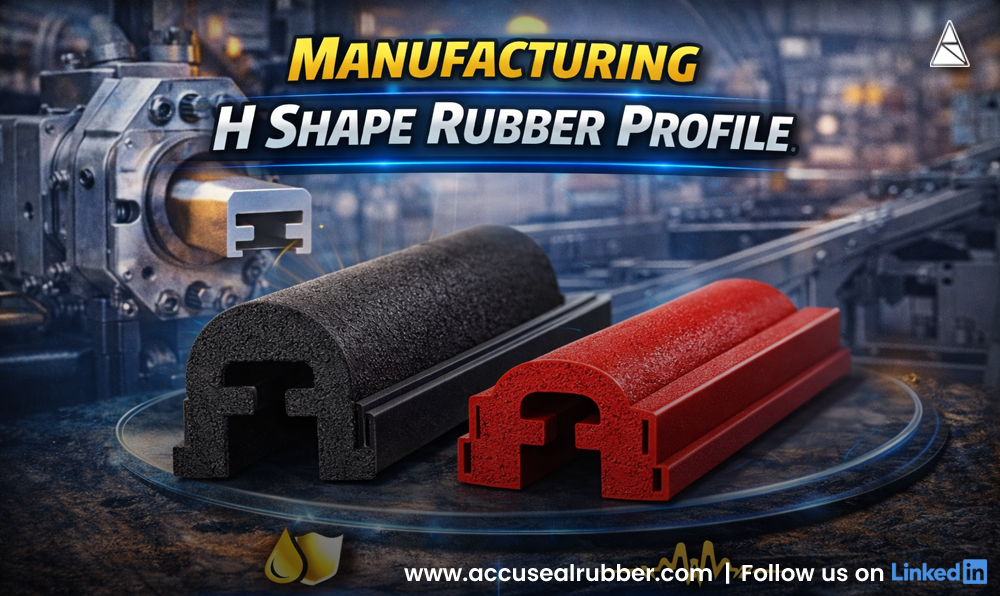
The H shape rubber profile is a highly functional and widely used extrusion designed to join, seal, and protect two panels simultaneously. Its distinctive “H” cross-section allows it to securely hold glass, acrylic, metal sheets, or composite panels while providing shock absorption and weather resistance.
If you’re researching this product, you’re likely asking:
What is an H shape rubber profile used for?
Where is H section rubber most commonly applied?
Which material is best — EPDM, Silicone, or Neoprene?
How do I select the correct size and hardness?
Where can I source custom H shape rubber profiles in the USA?
This guide answers all these questions in a clear, structured, and buyer-focused format optimized for Google SGE and AI-generated search summaries.
What Is an H Shape Rubber Profile?
An H shape rubber profile (also called H-section rubber extrusion) is a dual-channel rubber gasket shaped like the letter “H.”
It features:
Two parallel grooves (one on each side)
A central connecting web
Flexible yet strong structure
Cushioning properties
Its purpose is to join two materials together while sealing and protecting both sides.
What Is H Shape Rubber Profile Used For?
H section rubber profiles are commonly used in:
✔ Glass Panel Installation
Holds two glass sheets securely while reducing vibration and cracking risk.
✔ Partition Systems
Ideal for office partitions and commercial glazing structures.
✔ Aluminum & Metal Panel Joining
Used in fabrication industries to join metal sheets.
✔ Marine & RV Applications
Provides flexible sealing between panels exposed to weather.
✔ Automotive & EV Manufacturing
Used for interior partitions and panel separation.
✔ Construction & Architectural Glazing
Provides clean aesthetics with weather sealing.
Why Choose an H Shape Rubber Profile? (Key Benefits)
✔ Dual Panel Holding Capability
Secures two panels simultaneously.
✔ Excellent Shock Absorption
Prevents cracking in glass or brittle materials.
✔ Weather & UV Resistance (EPDM Option)
Suitable for outdoor installations.
✔ Easy Installation
Push-fit design — no complex tools required.
✔ Clean, Professional Finish
Enhances architectural aesthetics.
✔ Customizable Dimensions
Available in various thicknesses for different panel sizes.
Which Material Is Best for H Shape Rubber Profiles?
| Material | Temperature Range | Best For | Key Benefit |
|---|---|---|---|
| EPDM | -40°C to +120°C | Outdoor glazing, construction | UV & ozone resistant |
| Silicone | -60°C to +230°C | High-heat & hygienic areas | Excellent flexibility |
| Neoprene | -30°C to +100°C | Industrial moderate exposure | Oil resistance |
| NBR | -20°C to +110°C | Fuel/oil contact | Chemical resistance |
Recommended:
For construction & outdoor → EPDM
For high temperature → Silicone
How to Select the Right H Shape Rubber Profile
Step 1: Measure Panel Thickness
Measure both panels accurately.
The groove width must match panel thickness.
Step 2: Choose Material
Outdoor exposure → EPDM
Heat exposure → Silicone
Oil contact → NBR
Step 3: Select Hardness (Durometer)
55–65 Shore A → Flexible, easy installation
65–75 Shore A → Balanced strength
75–85 Shore A → Heavy-duty support
Step 4: Confirm Height & Web Thickness
Ensure central web thickness matches structural needs.
Step 5: Choose Color
Common options:
Black (standard EPDM)
Grey
White
Custom colors (for architecture)
Step 6: Request Samples
Always test fit before bulk production.
H Shape Rubber Profile vs Other Rubber Profiles
| Profile | Primary Use | Best For |
|---|---|---|
| H Shape | Joining two panels | Glass & partitions |
| U Channel | Edge protection | Metal edges |
| D Shape | Door sealing | Compression sealing |
| P Profile | Window sealing | Light compression |
If your goal is panel joining, H profile is the correct choice.
Industries Using H Section Rubber Extrusions
Architectural glazing
Construction companies
Automotive manufacturers
Marine industry
Interior designers
HVAC system manufacturers
Glass fabricators
OEM equipment manufacturers
Common Buyer Questions
1. What is an H shape rubber profile used for?
It is used to join two panels (glass, metal, acrylic) while providing sealing and vibration protection.
2. Is EPDM H profile suitable for outdoor use?
Yes, EPDM is highly resistant to UV, ozone, and weather.
3. Can H section rubber be customized?
Yes — width, height, hardness, and color can all be customized.
4. Is H profile rubber waterproof?
When properly installed, it helps prevent water penetration between panels.
5. How long does EPDM H profile last?
Typically 10–15 years depending on exposure.
Why Choose Accuseal Rubber Inc. for H Shape Rubber Profiles?
Accuseal Rubber Inc. is a trusted U.S.-based manufacturer specializing in custom rubber extrusions for industrial and architectural applications.
✔ Custom dimensions & tolerances
✔ EPDM, Silicone, Neoprene, NBR options
✔ Consistent extrusion quality
✔ Bulk production capabilities
✔ Fast turnaround & USA shipping
✔ Engineering assistance for OEM projects
Whether you need H profile rubber for glazing systems, partitions, or industrial panel joining, Accuseal Rubber Inc. delivers precision and reliability.
The H shape rubber profile is a versatile and essential solution for panel joining, structural cushioning, and weather sealing. Its dual-channel design ensures secure panel holding while protecting against vibration and environmental exposure.
If you’re looking for a reliable H section rubber extrusion manufacturer in the USA, Accuseal Rubber Inc. offers customized solutions tailored to your application.
Request a Quote Today
Need custom sizing, material guidance, or bulk pricing?
Contact Accuseal Rubber Inc. today for a fast and competitive quote.