 Nick Parker
Biopharmaceutical manufacturing and bioprocessing equipment often requires tubing that can integrate precisely with pumps, vessels, connectors, valves, sensors, and other process components. For equipment manufacturers and OEMs, selecting tubing is therefore more than choosing a material or standard size.
The tubing may need to meet specific dimensional, flexibility, temperature, pressure, fluid-handling, and assembly requirements while fitting within the overall equipment design.
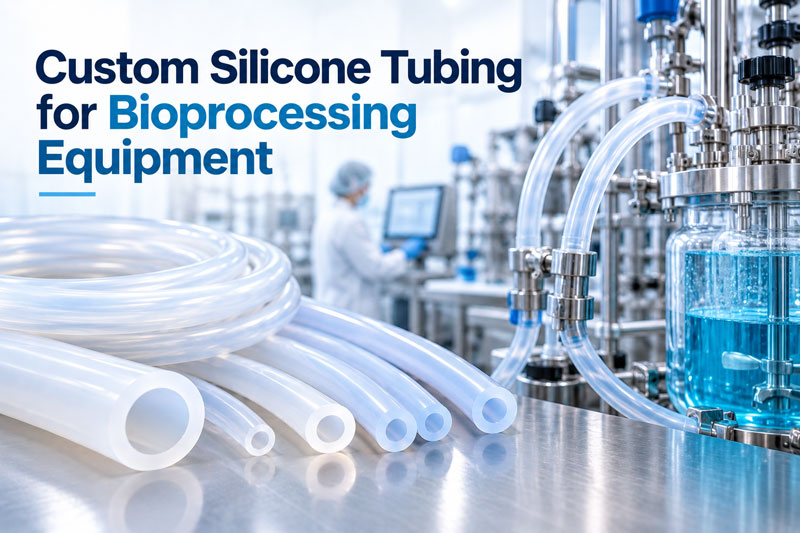
When standard tubing does not provide the required dimensions or configuration, custom silicone tubing for bioprocessing equipment can give OEMs greater flexibility during equipment development and production.
But what should a bioprocessing equipment manufacturer consider before ordering custom silicone tubing?
The answer starts with the application.
The right tubing specification depends on what the tubing does, what it carries, how it connects to the equipment, what operating conditions it experiences, and what requirements apply to the finished system.
Why Is Silicone Tubing Used in Bioprocessing Equipment?
Bioprocessing systems can involve the controlled movement of liquids, gases, process fluids, and other materials between different components.
Tubing may be incorporated into equipment for:
Fluid transfer
Sampling systems
Pumping systems
Laboratory and analytical equipment
Process connections
Liquid handling systems
Filtration equipment
Bioprocess equipment assemblies
Flexible connections between rigid components
Pharmaceutical and biotechnology equipment
Silicone tubing can be useful in applications where flexibility, temperature performance, and the ability to manufacture tubing in different dimensions are important.
However, not every silicone tube is automatically suitable for every biopharmaceutical application.
The tubing should be evaluated according to the actual process, material requirements, operating environment, and applicable quality or regulatory requirements of the finished equipment.
What Makes Custom Silicone Tubing Different?
Standard tubing is generally produced in predefined dimensions and configurations.
Custom silicone tubing allows an OEM to specify the tube around the requirements of its equipment.
Customization may involve:
Inside diameter
Outside diameter
Wall thickness
Length
Dimensional tolerances
Flexibility
Connection requirements
Packaging requirements
Production quantities
For example, a bioprocessing equipment manufacturer may have limited space between a pump and a process vessel. A standard tube may have an unsuitable outside diameter or bend characteristics.
A custom tube can be specified around the equipment’s actual layout.
This is particularly useful when tubing becomes an integral part of a proprietary OEM design.
1. Start With the Bioprocessing Application
Before selecting silicone tubing, define exactly what the tubing is expected to do.
Ask:
What is flowing through the tube?
Where is the tubing installed?
What components does it connect?
Is the tubing stationary or repeatedly moved?
What temperatures and pressures will it experience?
How often will the equipment be cleaned or serviced?
These questions provide the foundation for the tubing specification.
For example, tubing used for a fluid transfer connection may have different requirements from tubing incorporated into a pump assembly or sampling system.
The more clearly the application is defined, the easier it is for a custom tubing manufacturer to evaluate the requirements.
2. Define the Inside Diameter and Outside Diameter
For bioprocessing equipment manufacturers, ID and OD are critical specifications.
The inside diameter influences the available flow path, while the outside diameter determines how the tubing fits into the equipment and interfaces with connectors, clamps, channels, and other components.
OEMs should specify:
Required inside diameter
Required outside diameter
Wall thickness
Dimensional tolerance
Connection dimensions
A nominal tube size alone may not provide enough information for a custom manufacturing quotation.
If the tubing needs to connect to precision components, the required dimensions and tolerances should be clearly documented.
3. Determine the Required Wall Thickness
Wall thickness can affect the physical behavior of silicone tubing.
Depending on the application, it can influence:
Flexibility
Handling
Dimensional stability
Resistance to deformation
Connection with fittings
Installation characteristics
A bioprocessing equipment OEM should select wall thickness based on the actual equipment requirements rather than simply choosing the thickest or thinnest available option.
If the tubing passes through a compact assembly, for example, excessive wall thickness may make routing more difficult.
On the other hand, an application with specific mechanical requirements may need a different wall construction.
4. How Flexible Does the Tubing Need to Be?
Bioprocessing equipment can contain complex tubing paths.
Lines may need to pass around:
Pumps
Valves
Vessels
Filters
Sensors
Manifolds
Connectors
Other equipment components
This makes flexibility an important design consideration.
Before ordering custom silicone tubing, OEM engineers should determine:
Required bend radius
Available installation space
Whether the tube will be repeatedly bent
Whether components move relative to one another
How the tube will be secured
Whether the tube must maintain a particular shape
The goal is not simply maximum flexibility.
The objective is to find a tubing configuration that provides the appropriate balance of flexibility, dimensional stability, and mechanical behavior for the equipment.
5. Understand the Process Media
One of the most important pieces of information an OEM can provide to a silicone tubing manufacturer is the identity of the material passing through the tubing.
Depending on the system, this could involve:
Process liquids
Water
Buffers
Cleaning solutions
Gases
Pharmaceutical process fluids
Biological process materials
Other application-specific media
The manufacturer should understand the expected exposure conditions so that material suitability can be evaluated.
This is also where OEMs should avoid making assumptions based solely on the word “silicone.”
Different silicone formulations and tubing constructions can have different characteristics.
6. Consider Temperature Requirements
Bioprocessing equipment may encounter different temperatures during operation, cleaning, processing, or storage.
OEMs should identify:
Normal operating temperature
Minimum operating temperature
Maximum operating temperature
Short-term temperature exposure
Cleaning temperatures
Storage conditions
These requirements should be communicated during the sourcing process.
The tubing manufacturer can then evaluate the requirements against the proposed material and manufacturing approach.
7. Evaluate Pressure and Vacuum Conditions
Does the tubing operate under pressure?
Does it experience vacuum?
Does a pump create changing pressure conditions?
These questions matter when selecting tubing for process equipment.
OEMs should provide information about:
Normal operating pressure
Maximum pressure
Vacuum conditions
Pressure fluctuations
Pumping conditions
Duration of exposure
Tubing selection should be based on the complete application rather than dimensions alone.
8. Consider Cleaning and Process Conditions
Bioprocessing equipment can require defined cleaning and maintenance procedures.
The tubing may therefore be exposed to cleaning agents, elevated temperatures, repeated handling, or other process conditions.
Before selecting tubing, OEMs should understand:
How the tubing will be cleaned
How frequently it will be cleaned
Whether cleaning occurs in place or after removal
What cleaning media are involved
Whether temperature changes occur during cleaning
Whether the tubing is replaced periodically
These details should be shared with the tubing manufacturer before finalizing the material specification.
9. Think About Connections and Fittings
Custom silicone tubing is often installed as part of a larger assembly.
It may connect to:
Pumps
Valves
Manifolds
Filters
Process vessels
Connectors
Rigid tubing
Sampling components
Other equipment
The tubing’s ID and OD should therefore be selected together with the dimensions of the components it connects to.
A small dimensional mismatch can make assembly difficult or require additional adapters.
For OEMs, designing the tubing and connection system together can simplify equipment assembly.
Standard vs. Custom Silicone Tubing for Bioprocessing
Should an OEM use standard tubing or order a custom silicone tube?
It depends on the application.
| Requirement | Standard Silicone Tubing | Custom Silicone Tubing |
|---|---|---|
| Common dimensions | Suitable | Suitable |
| Non-standard ID/OD | Limited | Suitable |
| Specific wall thickness | Limited to available sizes | Can be specified |
| Custom lengths | Depends on supplier | Can be specified |
| Proprietary equipment design | May require adaptation | Can be designed around requirements |
| Prototype development | Depends on availability | Useful |
| Repeat OEM production | Product-dependent | Can be planned around specifications |
| Special tolerances | Limited by product | Can be defined for project |
| Equipment integration | May require modification | Greater design flexibility |
If an existing standard tube meets all application requirements, customization may not be necessary.
However, if the equipment requires unusual dimensions, specific routing, or precise component integration, custom manufacturing can be a more practical approach.
10. What About Regulatory and Quality Requirements?
This is an area where biopharmaceutical OEMs need to be particularly precise.
Terms such as “pharmaceutical grade,” “medical grade,” or “biopharmaceutical grade” should not be treated as interchangeable descriptions.
The appropriate material, testing, documentation, and compliance requirements depend on the intended application and the finished system.
Before requesting a quote, OEMs should identify the specific requirements applicable to their project.
These may include requirements related to:
Material traceability
Quality documentation
Material specifications
Testing
Lot identification
Packaging
Applicable industry or regulatory requirements
Rather than assuming that a particular silicone tube meets a requirement, OEMs should communicate the exact documentation and compliance expectations to the manufacturer during the sourcing process.
11. Prototype Requirements Should Be Discussed Early
Bioprocessing equipment often goes through several development stages:
Concept → Prototype → Testing → Validation → Production
The tubing requirements may evolve during these stages.
An OEM may initially need a small quantity for:
Equipment prototypes
Fit testing
Flow testing
Assembly evaluation
Design verification
Later, the same project may require significantly larger quantities.
When choosing a custom silicone tubing supplier, discuss both prototype and expected production requirements.
This allows the supplier to understand the potential long-term project requirements from the beginning.
12. What Should Be Included in a Custom Silicone Tubing RFQ?
A well-prepared RFQ can make communication between an OEM and tubing manufacturer much easier.
Ideally, include:
| Requirement | Information to Provide |
|---|---|
| Application | What the tubing does |
| Industry | Biopharmaceutical/bioprocessing application |
| Material | Required silicone specification, if known |
| ID | Inside diameter |
| OD | Outside diameter |
| Wall thickness | Required wall |
| Length | Cut length or continuous tubing |
| Tolerance | Dimensional requirements |
| Process media | Fluid, gas, or other material |
| Temperature | Operating and cleaning conditions |
| Pressure | Operating and maximum conditions |
| Vacuum | If applicable |
| Connections | Fittings and mating components |
| Quantity | Prototype and production requirements |
| Drawing | Engineering drawing/CAD file |
| Sample | Existing tubing sample |
| Documentation | Required quality/compliance documents |
| Packaging | Required packaging format |
Providing this information upfront can reduce back-and-forth communication and help a custom silicone tubing manufacturer understand the project more accurately.
What Questions Should OEMs Ask a Silicone Tubing Manufacturer?
Before selecting a supplier, bioprocessing equipment manufacturers should consider asking:
Can you manufacture custom silicone tubing to our engineering drawing?
This determines whether the supplier can manufacture tubing according to the OEM’s specific design.
Can you work from a physical sample?
A sample can be useful when replacing an existing tube or reproducing a component.
What ID, OD, wall thickness, and tolerance combinations can you manufacture?
This helps determine whether the supplier can accommodate the equipment’s design.
Can you support prototype quantities?
Small quantities may be necessary during equipment development.
Can you support recurring production?
If the tubing will become part of an established equipment platform, production consistency and supply planning become important.
What documentation is available for the required application?
The OEM should identify documentation requirements before production begins.
Common Mistakes When Sourcing Silicone Tubing for Bioprocessing Equipment
Some sourcing problems can be prevented simply by providing better specifications.
Common mistakes include:
Specifying only the inside diameter
Not providing wall thickness
Ignoring dimensional tolerances
Not identifying the process media
Failing to communicate temperature requirements
Ignoring pressure or vacuum conditions
Choosing tubing based solely on price
Assuming all silicone tubing has the same characteristics
Not discussing cleaning conditions
Waiting until production to define documentation requirements
Not providing an engineering drawing
Selecting a supplier without discussing future production volumes
For custom OEM projects, a detailed specification at the beginning can make the sourcing process significantly more efficient.
When Should You Choose Custom Silicone Tubing?
Custom silicone tubing is particularly worth considering when:
Standard tubing dimensions do not fit the equipment
The OEM requires a specific ID and OD combination
A particular wall thickness is needed
Tubing must fit within a limited space
Custom cut lengths are required
Tubing needs to interface with proprietary components
Specific dimensional tolerances are required
Prototype tubing is needed for equipment development
The same custom tubing will be required for recurring production
The objective is not to customize tubing unnecessarily.
Instead, customization should be used when it solves a genuine equipment design, assembly, or manufacturing requirement.
Choosing a Custom Silicone Tubing Manufacturer
For biopharmaceutical and bioprocessing equipment OEMs, supplier selection should go beyond whether a company sells silicone tubing.
Look for a manufacturer capable of understanding and supporting:
Custom tubing requirements
Engineering drawings
Physical samples
Dimensional specifications
Prototype development
Production quantities
OEM applications
Application-specific material requirements
Quality and documentation expectations
An experienced custom tubing supplier can become a useful manufacturing partner during equipment development rather than simply a source of standard tubing.
Custom Silicone Tubing for Bioprocessing Equipment from Accuseal Rubber
Accuseal Rubber Inc. provides custom rubber and silicone manufacturing solutions for customers with application-specific requirements.
For OEMs developing biopharmaceutical and bioprocessing equipment, the sourcing process can begin with the project’s engineering information, including tubing dimensions, drawings, samples, application details, operating conditions, connection requirements, and expected quantities.
Providing these details allows the requirements to be evaluated before a custom tubing solution is proposed.
Whether you are developing a new bioprocessing machine, modifying an existing equipment platform, or looking for a custom replacement tube, discussing the application with the manufacturer early can help identify the appropriate manufacturing approach.
Request a Custom Silicone Tubing Quote
Are you developing biopharmaceutical or bioprocessing equipment that requires custom silicone tubing?
Provide Accuseal Rubber with your:
Engineering drawing or CAD file
Existing tubing sample, if available
Inside and outside diameter
Wall thickness
Required length
Dimensional tolerances
Process media
Temperature and pressure conditions
Connection requirements
Prototype or production quantity
Documentation requirements
The more complete the specification, the easier it is to evaluate the requirements and determine an appropriate custom tubing solution.
Looking for a custom silicone tubing manufacturer for bioprocessing equipment? Contact Accuseal Rubber to discuss your requirements and request a quote.
Frequently Asked Questions About Custom Silicone Tubing for Bioprocessing
What is custom silicone tubing for bioprocessing equipment?
Custom silicone tubing is tubing manufactured according to specific OEM requirements, such as ID, OD, wall thickness, length, tolerances, flexibility, and application conditions. It can be designed around the equipment rather than relying solely on standard catalog dimensions.
How do I choose silicone tubing for a bioprocessing application?
Start by defining the tubing’s function, process media, ID, OD, wall thickness, flexibility, temperature, pressure or vacuum conditions, connection requirements, cleaning conditions, and applicable quality or documentation requirements.
Can silicone tubing be customized for biopharmaceutical equipment?
Custom silicone tubing can be manufactured to customer-specific dimensions and requirements, depending on the manufacturer’s capabilities and the project’s technical specifications.
What information should I provide when requesting a custom silicone tubing quote?
Provide the application, material requirements, ID, OD, wall thickness, length, tolerances, process media, operating temperature, pressure or vacuum conditions, connections, quantity, and preferably an engineering drawing or physical sample.
What size silicone tubing is used for bioprocessing equipment?
There is no single size suitable for all bioprocessing applications. The appropriate ID, OD, and wall thickness depend on the equipment design, flow requirements, connections, operating conditions, and other application-specific factors.
Can a silicone tubing manufacturer work from an engineering drawing?
Many custom tubing manufacturers can work from engineering drawings and physical samples. OEMs should provide their drawings and confirm the supplier’s manufacturing capabilities during the quotation process.
Is all silicone tubing suitable for pharmaceutical or biopharmaceutical applications?
No. Silicone tubing should be evaluated according to the specific application, material requirements, operating conditions, quality requirements, and applicable regulatory or documentation expectations. OEMs should communicate these requirements clearly to the manufacturer.
Why do bioprocessing equipment manufacturers use custom tubing?
Custom tubing can help when standard sizes do not fit the equipment, when specific ID/OD combinations or wall thicknesses are required, or when the tubing needs to integrate with proprietary equipment and connections.
Can OEMs order prototype quantities of custom silicone tubing?
Prototype requirements should be discussed with the manufacturer during the design stage. Depending on the supplier’s capabilities, custom tubing can be produced for initial equipment development and testing before recurring production.
How can I find a custom silicone tubing manufacturer in the USA?
Look for a manufacturer with experience in custom silicone tubing, OEM applications, engineering drawings, prototype development, dimensional requirements, and production manufacturing. Providing your specifications and application details when requesting a quotation can help determine whether the supplier is suitable for the project.
Where can I request custom silicone tubing for bioprocessing equipment?
OEMs can contact Accuseal Rubber with their tubing specifications, engineering drawings or samples, application information, operating conditions, and required quantities to discuss a potential custom silicone tubing project.
Final Takeaway
For biopharmaceutical and bioprocessing equipment manufacturers, silicone tubing should be treated as an engineered component of the equipment, not simply a commodity item.
The right tubing depends on the complete application—including dimensions, wall thickness, flexibility, process media, temperature, pressure, vacuum, connections, cleaning conditions, tolerances, documentation requirements, and production volume.
When standard tubing meets the application requirements, it may be sufficient. When it does not, custom silicone tubing can provide OEMs with greater flexibility to integrate tubing into specialized equipment designs.
The best time to define those requirements is during the equipment design and sourcing stage.
If your company is developing or manufacturing biopharmaceutical or bioprocessing equipment, provide your specifications, drawing, sample, or application details to Accuseal Rubber to discuss a custom silicone tubing solution.
Need custom silicone tubing for bioprocessing equipment? Request a quote from Accuseal Rubber today.