 Nick Parker
When it comes to the oil and gas sector, every seal, gasket, and molded part plays a critical role in maintaining efficiency, safety, and uptime. From offshore rigs and subsea drilling systems to refineries and LNG plants, even a small material failure can lead to major operational losses. That’s why choosing the right rubber products for oil and gas applications isn’t just about durability—it’s about ensuring long-term reliability, chemical resistance, and performance under extreme pressure and temperature.
In our detailed post Supporting the Oil & Gas Industry with High-Quality Rubber Solutions, we explained how Accuseal Rubber Inc. designs high-performance rubber components that thrive in some of the harshest industrial environments. This supporting blog dives deeper into the selection process, material comparison, and key buying considerations to help engineers, procurement teams, and maintenance professionals make confident decisions.
Why Rubber Selection Matters in the Oil & Gas Industry
Rubber is a vital material in oil and gas operations because of its flexibility, resilience, and sealing strength. Whether used in gaskets, O-rings, seals, vibration dampers, or insulation mats, the right rubber material ensures:
Leak-free sealing in pipelines, valves, and wellheads
Resistance to hydrocarbon exposure and chemical corrosion
Safety assurance in explosive or high-voltage environments
Reduced downtime and maintenance costs
However, not all rubber materials are created equal. Understanding which compound to choose—and why—can directly impact the performance and longevity of your equipment.
Common Questions About Rubber Products in Oil & Gas
1. What kind of rubber is best for oil and gas applications?
The answer depends on your environment.
Here’s a quick comparison of commonly used materials:
| Rubber Type | Best For | Temperature Range (°C) | Key Resistance Properties |
|---|---|---|---|
| Nitrile (NBR) | Oil, fuel, hydrocarbon resistance | -30 to +120 | Excellent oil and fuel resistance |
| EPDM | Steam, water, weather exposure | -50 to +150 | UV and ozone resistant, poor with oil |
| FKM (Viton®) | High temperatures and chemicals | -20 to +200 | Resistant to acids, fuels, and solvents |
| Neoprene | Moderate oils, weather, flame resistance | -40 to +120 | Balanced performance in outdoor use |
| HNBR | High-pressure systems | -40 to +150 | Superior mechanical strength and oil resistance |
| Silicone | Extreme temperature flexibility | -60 to +230 | Excellent for thermal cycling, less oil resistant |
When in doubt, consult with a specialized rubber manufacturer for oil and gas components—such as Accuseal Rubber Inc.—to identify the best formulation for your pressure, temperature, and chemical conditions.
2. What are the main types of rubber components used in oil and gas?
Common rubber components include:
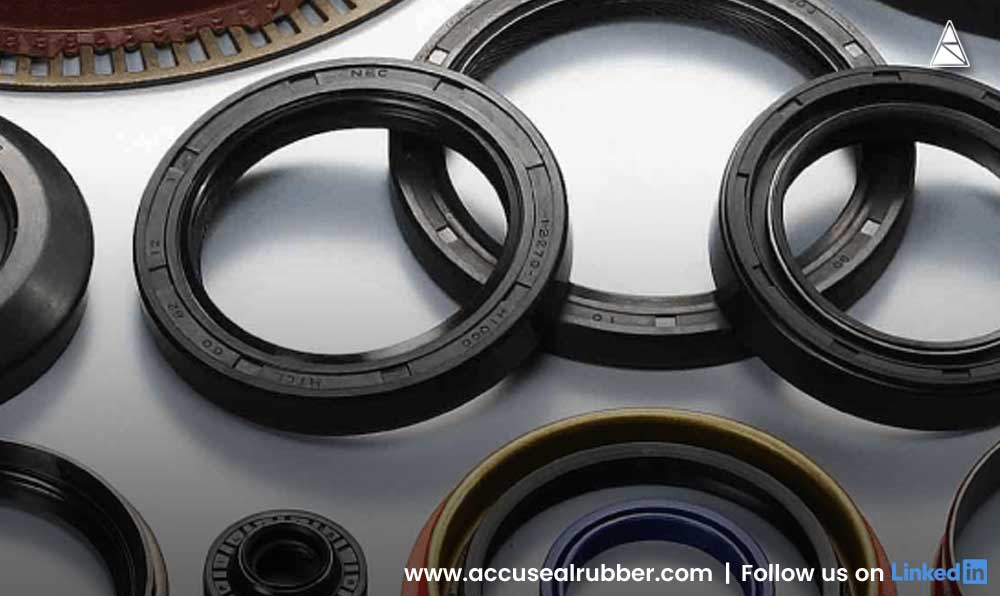
Seals and O-Rings: Prevent fluid and gas leaks under high pressure.
Gaskets: Provide static sealing in flanges and pipeline joints.
Diaphragms: Control pressure or flow in pumps and regulators.
Vibration mounts and pads: Absorb mechanical shocks in heavy-duty equipment.
Non-conductive mats: Improve operator safety in electrical environments.
Each of these components can be custom molded to meet API, ISO, and NORSOK standards, ensuring reliability and performance.
3. How to ensure the rubber compound is suitable for aggressive chemicals?
Oil and gas operations often involve contact with crude oil, acids, sour gas (H₂S), solvents, and abrasive slurries.
To verify chemical compatibility:
Identify all contact fluids. Include drilling muds, hydrocarbons, and cleaning agents.
Check compound datasheets. Reputable manufacturers provide compatibility charts.
Test a sample part. Conduct immersion or swelling tests before bulk production.
Work with experts. Companies like Accuseal Rubber Inc. offer lab-tested compounds proven against benzene, toluene, and hydrogen sulfide exposure.
By using a chemically resistant rubber compound, you can reduce premature failure, minimize replacement cycles, and ensure safe, continuous operation.
How to Choose the Right Supplier for Oil & Gas Rubber Components
Choosing a supplier is as critical as selecting the material itself. When sourcing rubber components for oilfield or refinery operations, look for:
✅ 1. Proven Industry Experience
Suppliers familiar with upstream, midstream, and downstream environments understand the challenges of pressure, heat, and chemical exposure. Their prior project experience ensures faster troubleshooting and smarter material recommendations.
✅ 2. Custom Formulation Capabilities
Oilfield and refinery systems often need tailor-made compounds to meet performance or compliance standards.
Ask if your supplier can:
Modify durometer hardness
Adjust compression set resistance
Develop proprietary blends for specific chemical profiles
Accuseal Rubber Inc., for instance, provides in-house formulation and testing, ensuring the rubber performs precisely as your application demands.
✅ 3. Quality Certifications
Reliable suppliers should meet or exceed:
API (American Petroleum Institute) standards
ISO 9001/14001 quality systems
NORSOK M-710 for elastomeric materials
These certifications demonstrate consistent quality and industry compliance.
✅ 4. Rapid Prototyping and Sampling
Before committing to bulk orders, ask for prototypes or short-run batches. This allows you to verify fit, function, and compatibility before full-scale production.
✅ 5. End-to-End Support
An ideal partner doesn’t just ship parts—they collaborate with your engineers, perform failure analysis, and suggest design or material improvements for long-term reliability.
Actionable Tips for Maximizing Rubber Component Lifespan
Select the correct compound for the operating temperature and media.
Avoid over-compression during installation; it shortens seal life.
Inspect regularly for signs of hardening, swelling, or cracking.
Store properly in a cool, dark, and dry environment away from ozone or UV exposure.
Replace proactively before scheduled turnarounds to avoid unplanned shutdowns.
These small steps can drastically increase equipment uptime and reduce the total cost of ownership.
Frequently Asked Questions (FAQs)
Q1. What is the best rubber for high-pressure oilfield seals?
HNBR and FKM (Viton®) are top choices. Both offer high mechanical strength and resistance to oil, gas, and high temperature. HNBR is preferred for dynamic sealing in BOPs, wellheads, and pipelines.
Q2. Are rubber gaskets suitable for crude oil pipelines?
Yes, but ensure the gasket material has hydrocarbon and chemical resistance. Nitrile and Viton® compounds are ideal for crude oil transport lines due to their compatibility and sealing integrity.
Q3. Can rubber seals handle extreme cold environments like Arctic drilling?
Absolutely. EPDM and silicone rubber maintain elasticity and resilience at subzero temperatures, preventing brittleness or cracking.
Q4. How often should rubber components be replaced in refineries?
It depends on exposure conditions, but preventive replacement every 12–18 months is common for high-stress seals and gaskets. Always refer to your supplier’s recommendations.
Q5. Where can I buy custom rubber parts for oil and gas equipment?
You can source directly from specialized manufacturers like Accuseal Rubber Inc., which offers custom-molded gaskets, seals, and insulating components designed for oilfield and refinery use.
Why Choose Accuseal Rubber Inc. for Oil & Gas Rubber Components
Accuseal Rubber Inc. has decades of experience engineering mission-critical rubber products for the global oil and gas sector. Our products are trusted by top operators for their reliability, performance, and long service life—even under extreme conditions.
What sets us apart:
Custom formulations for every pressure, chemical, and temperature challenge
Batch-certified manufacturing for total traceability
Rapid design-to-delivery process
Global compliance with API, ISO, and NORSOK standards
For a deeper look into our solutions, visit our in-depth article Supporting the Oil & Gas Industry with High-Quality Rubber Solutions.
Ready to Optimize Your Oil & Gas Operations?
If your facility is facing frequent seal failures, vibration issues, or chemical degradation, it’s time to upgrade your components with high-quality rubber solutions designed for the toughest conditions.
Contact Accuseal Rubber Inc. today to:
Request a free consultation or quote
Get expert help selecting the ideal compound
Discover how custom rubber engineering can enhance uptime, safety, and profitability
Accuseal Rubber Inc. — Precision. Performance. Protection.
Where innovation meets reliability for the oil and gas industry.