 Nick Parker
⚡ Looking for Custom Tooling or Fast OEM Prototyping?
Have a specialized cross-section or 2D/3D print? Accuseal Rubber manufactures custom extrusion dies in-house at our New Brunswick, New Jersey facility—cutting prototype lead times from months to days.
➔ Upload Your CAD Drawing (.STEP / .DWG / PDF) for a Rapid 24-Hour RFQ Review
What Is Custom Silicone Profile Extrusion?
Direct Answer: Custom silicone profile extrusion is a manufacturing process where raw silicone elastomeric compound is continuously forced through a precision-machined steel die to produce uniform cross-sectional profiles such as D-seals, U-channels, tubing, and complex multi-lumen shapes. The shaped silicone then passes through a heated vulcanization oven (curing tunnel) to permanently lock in its mechanical and thermal properties.
Silicone is chosen over general rubbers like EPDM or Nitrile when applications require high continuous heat resistance (-60°C to +200°C), superior compression set recovery, biocompatibility, or high environmental sealing durability.
Why Choose a Domestic In-House Silicone Extrusion Manufacturer in the USA?
Direct Answer: Sourcing custom silicone extrusions from a domestic US manufacturer with in-house die-making eliminates overseas supply chain disruptions, reduces prototype lead times by 70%, and ensures compliance with domestic standards such as FDA 21 CFR 177.2600, USP Class VI, and RMA dimensional classes.
When engineering custom seals, outsourcing die fabrication to overseas brokers introduces multi-week delays for simple tooling revisions and high risks of tolerance failure. Accuseal Rubber manages die design, wire EDM cutting, continuous curing, and QA under one roof in New Jersey.
In-House USA Manufacturing vs. Outsourced Sourcing
| Engineering Capability | Accuseal Rubber Inc. (In-House USA) | Typical Offshore / Broker Model |
| Die Fabrication Location | In-house wire EDM & CNC tooling (New Jersey) | 3rd-party die shops or overseas |
| Tooling & Sample Lead Time | 1 to 2 Weeks | 6 to 10 Weeks |
| Die Tuning & Profile Revisions | Same-week design adjustments | 3 to 5 weeks per shipment cycle |
| Dimensional Tolerances | RMA Class 1 (High Precision) & Class 2 | Often RMA Class 3 (Commercial only) |
| Material Traceability | Certified virgin compounds with lot COAs | Variable resin purity and filler ratios |
| Production Run Flexibility | Low-volume prototypes to high-volume OEM runs | High container-level minimums |
| Direct Engineering Support | Speak directly with tooling and materials staff | Tiered support through non-technical agents |
What Types of Extruded Silicone Profiles Are Available?
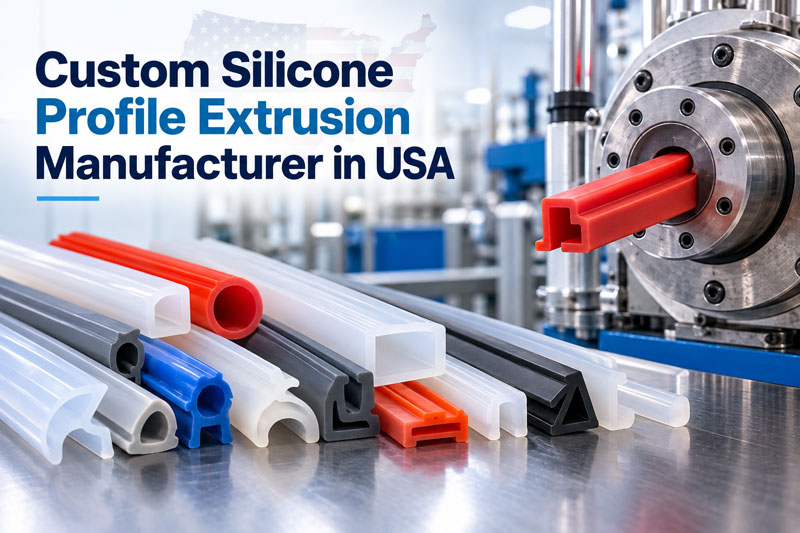
Accuseal Rubber extrudes a wide catalog of standard and complex custom geometries for OEM assemblies:
D-Shape & P-Seals: Features a hollow or solid bulb that compresses under minimal force, making it ideal for door enclosures, cleanroom hatches, and electrical cabinets.
U-Channels & Edge Protectors: Slotted profiles designed for snap-on or friction-fit edge protection along sheet metal, glass panels, and transit doors.
H-Profiles & T-Shapes: Specialized architectural profiles engineered for commercial glazing, curtain wall joints, and solar module framing.
Hollow Cords & O-Ring Extrusions: Continuous round cord and hollow elastomeric tubing used for field-spliceable static gasket seals.
Multi-Lumen & Custom Geometric Dies: Intricate multi-channel configurations manufactured directly from customer CAD models (.STEP / .DWG / .IGES).
Solid vs. Closed-Cell Silicone Sponge Extrusions: Which Do You Need?
Direct Answer: Solid silicone extrusions offer higher tensile strength and tear resistance for high-pressure static joints or fluid-handling seals. Closed-cell silicone sponge profiles offer much lower closure force and superior compressibility, making them ideal for lightweight enclosures, outdoor weatherproofing, and dust/moisture barriers.
Engineering Material Comparison
| Property | Solid Extruded Silicone | Closed-Cell Silicone Sponge |
| Hardness / Density Range | 30 to 80 Shore A | 10 to 35 lbs/cu.ft ($160\text{ to }560\text{ kg/m}^3$) |
| Operating Temperature | -60°C to +200°C (-76°F to +392°F) | -60°C to +200°C (-76°F to +392°F) |
| Peak Temperature (Short-term) | Up to +250°C (Specialty grades up to +300°C) | Up to +230°C (+446°F) |
| Compression Deflection | Requires higher clamping load | Seals under light door/closure latching |
| Sealing Certification Suitability | IP66, IP67, IP68 immersion seals | NEMA 4, NEMA 4X, IP65 weather seals |
| Compliance Availability | FDA 21 CFR 177.2600, USP Class VI, UL 94-V0 | UL 94-HB, UL 94-V0 flame retardant |
What Dimensional Tolerances Apply to Silicone Extrusions?
Direct Answer: Custom silicone extrusions are measured against RMA (Rubber Manufacturers Association) dimensional tolerance standards. Accuseal Rubber manufactures custom profiles adhering to RMA Class 1 (High Precision) and RMA Class 2 (Precision) specifications.
RMA Class 1 (High Precision): Applies to critical aerospace, medical, and optical sealing applications where space envelopes are tight and variations must be held to fractions of a millimeter. Requires dedicated tooling tuning and optical inspection.
RMA Class 2 (Precision): The recommended standard for most industrial, automotive, and electronic enclosure sealing profiles. Balances tight dimensional stability with economical production throughput.
RMA Class 3 (Commercial): Standard for non-critical edge trims, bumper guards, and cosmetic finishing strips.
Every production batch at Accuseal Rubber is verified using optical measurement systems, calipers, and durometers to ensure consistent wall thickness and outer diameter tolerances across high-volume production.
Secondary Fabrication & Custom Finishing Services
To reduce assembly labor on your production floor, we provide in-line and secondary processing options:
Pressure-Sensitive Adhesive (PSA) Application: High-temperature acrylic or silicon-based double-sided adhesive backing applied directly for peel-and-stick mounting.
Precision Cut-to-Length: Automated cutting to deliver exact cut lengths or loose rings ready for workstation assembly.
Endless Vulcanized Splicing: 90-degree corner joints and continuous vulcanized rings to create ready-to-install rectangular or circular gasket frames.
Custom Marking & Color Matching: Direct inkjet part marking, date codes, and custom RAL/Pantone color compounding.
Frequently Asked Questions (FAQ)
What is the typical lead time for a custom silicone extrusion die?
Because Accuseal Rubber manufactures dies in-house in New Jersey, tooling fabrication and initial pre-production sample extrusions typically take 1 to 2 weeks, compared to 6 to 10 weeks when dealing with third-party or offshore toolmakers.
What files do you require to quote a custom silicone profile?
We accept standard 2D and 3D CAD formats, including .STEP, .STP, .DWG, .DXF, .IGES, or fully dimensioned engineering PDFs. If you do not have a CAD file, you can send an existing physical sample cross-section for reverse-engineering.
Can extruded silicone withstand fuels and synthetic oils?
Standard polydimethylsiloxane (silicone) rubber swells when exposed to petroleum-based fuels, gasoline, and aromatic solvents. For applications requiring silicone’s temperature extremes alongside fuel or oil resistance, Accuseal Rubber manufactures profiles using Fluorosilicone (FVMQ) compounds.
What is the minimum order quantity (MOQ) for custom profiles?
We provide flexible production batches, supporting small-run pilot prototypes and design validations through to high-volume multi-thousand-foot OEM production orders.
Request an Engineering Review & Rapid Quote
Ensure your custom silicone profile matches your exact dimensional, thermal, and regulatory requirements. Contact our New Jersey engineering and manufacturing team today:
Email: info@accusealrubber.com
Facility Address: 18-F Home News Row, New Brunswick, NJ 08901, USA
Direct RFQ: Submit your CAD drawing (.STEP, .DWG, or PDF) for a prompt technical review and pricing quote within 24 hours.