 Nick Parker
⚡ Need Custom Inflatable Seals for Cleanrooms or Pressure Vessels?
Accuseal Rubber manufactures high-performance pneumatic inflatable seals with in-house fabric reinforcement and precision vulcanization in New Jersey. Standard cross-sections or custom CAD engineering for sterile chambers, marine hatches, and isolation doors.
➔ Upload Your CAD Drawing (.STEP / .DWG / PDF) or Groove Specs for a Rapid 24-Hr RFQ
What Is an Air Inflatable Seal and How Does It Work?
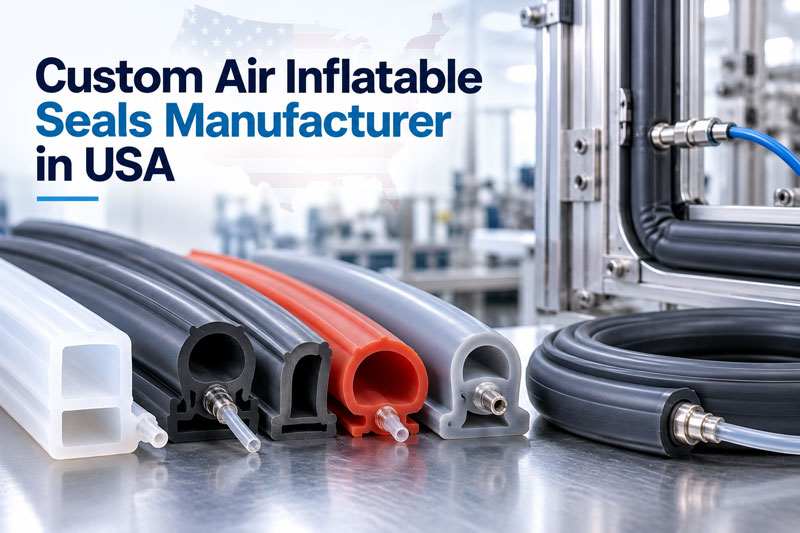
Direct Answer: An air inflatable seal (pneumatic seal) is a hollow elastomeric profile that expands and contracts pneumatically using compressed air or fluid media. When pressure (typically 5 to 50+ PSI) is applied through an integrated valve stem, the seal inflates to bridge gaps and create an airtight, watertight barrier across irregular or moving mating surfaces. Deflating the seal retracts it flush into its mounting channel, permitting frictionless clearance for doors, slides, or hatches.
Unlike standard static compression gaskets that require heavy mechanical clamping or bolts, inflatable seals expand dynamically—compensating for structural misalignment, thermal expansion, and uneven tolerances with zero latching wear.
Inflatable Seal Expansion Profiles: Radial vs. Axial
Choosing the proper expansion profile is the most critical engineering factor for ensuring leak-tight retention without pinching or premature fatigue.
| Expansion Geometry | Deflated State | Inflated Direction | Typical Applications |
| Radial Inward (Radial In) | Sits in outer circular/annular housing | Expands inward toward the center axis | Shaft clamping, cylindrical plug sealing, pipe testing |
| Radial Outward (Radial Out) | Sits around an internal hub/core | Expands outward against outer walls | Drum containment, pipe stoppers, round hatch access |
| Axial (Face / Push Up) | Sits flat in a recessed groove | Expands 90° vertically upward | Sliding doors, sterile isolators, cleanroom pass-throughs |
| Straight Lengths / U-Frames | Extruded with vulcanized sealed ends | Expands outward along single planes | Sluice gates, marine ramp doors, conveyor clamps |
Inflatable Seals vs. Traditional Compression Gaskets
| Performance Factor | Custom Inflatable Seals | Traditional Solid/Sponge Gaskets |
| Closure Mechanism | Automated pneumatic pressure | Manual torque, bolts, or latching levers |
| Tolerance Compensation | Absorbs large, uneven gap variations (up to 1″+) | Limited to 20%–30% compression deflection |
| Seal Wear & Friction | Zero sliding friction (inflates only when closed) | High sliding abrasion and tear risk |
| Cycle Life | 100,000+ inflation cycles without set fatigue | Permanent compression set over time |
| Sanitary Compliance | Seamless clean-in-place (CIP / SIP) capability | Crevices harbor bacteria and fluid pooling |
Material Compounds & Operating Specifications
Accuseal Rubber compounds and cures pneumatic seals to withstand extreme operating conditions, high sterilization cycles, and harsh chemical exposure:
| Elastomeric Compound | Durometer (Shore A) | Temperature Range | Primary Applications |
| Medical / Food-Grade Silicone | 40 to 65 Shore A | -60°C to +200°C (-76°F to +392°F) | Pharma autoclaves, cleanrooms (FDA & USP Class VI) |
| Fluorosilicone (FVMQ) | 50 to 70 Shore A | -60°C to +200°C (-76°F to +392°F) | Aerospace fuel bays, chemical vapor containment |
| EPDM (Dense & Reinforced) | 50 to 70 Shore A | -40°C to +135°C (-40°F to +275°F) | Outdoor weather gates, steam environments, water treatment |
| Neoprene / Nitrile (NBR) | 50 to 70 Shore A | -30°C to +100°C (-22°F to +212°F) | Marine bulkhead doors, oil-mist industrial enclosures |
Note: For high-pressure operations (>30 PSI), profiles can be engineered with internal synthetic fabric reinforcement (Dacron/Nomex/Nylon) to prevent ballooning and burst failure.
Air Fittings, Valves, and Corner Configurations
To ensure seamless installation into your pneumatic system, we customize the pneumatic connections and frame geometries in-house:
Integrated Inflation Valves: Stainless steel, brass, or flexible elastomer Schrader valves, barbed stems, or threaded push-in fittings vulcanized directly into the base or end.
Continuous Spliced Loops & Molded Corners: Seamless vulcanized circular rings or 4-corner rectangular frames molded with specific corner radii to prevent air-channel choking.
Retracted Profiles: Designed with built-in memory elastomeric walls so the profile snaps back completely into the groove during deflation, preventing snags during door operation.
Primary OEM & Industrial Applications
Pharmaceutical & Cleanroom Equipment: Airtight barrier isolators, lyophilizers, pass-through airlocks, and sterilizer autoclave doors.
Marine & Naval Defense: Watertight hatch seals, submarine torpedo door barriers, and floodgate sealing systems.
Aerospace & Defense: Canopy seals, altitude test chamber doors, and specialized acoustic/environmental enclosures.
Bulk Powder & Solids Handling: Pneumatic valves, mixer discharge ports, and dust-collection chute seals.
Frequently Asked Questions (FAQ)
What operating pressure (PSI) is required for air inflatable seals?
Operating inflation pressure typically ranges from 10 to 35 PSI (0.7 to 2.4 bar) for standard sealing gaps (3/16″ to 1/2″). Heavy-duty or fabric-reinforced seals can be engineered for pressures exceeding 50+ PSI, depending on the gap size and differential pressure requirements.
Can an inflatable seal bridge an uneven or tapered gap?
Yes. One of the greatest advantages of pneumatic inflatable seals is their ability to expand non-uniformly, effortlessly conforming across variable, warped, or non-parallel mating surfaces where standard flat gaskets fail.
How do you prevent inflatable seals from bursting during over-pressurization?
We provide clear maximum pressure ratings based on your profile’s expansion envelope. Additionally, we integrate synthetic fabric reinforcement plies into high-stress elastomeric compounds to limit radial distortion and reinforce puncture resistance.
Request an Engineering Review & Custom Inflatable Seal Quote
From prototype design validation to full OEM equipment production, Accuseal Rubber delivers pneumatic sealing systems with domestic precision and speed.
Email Specifications & CAD: info@accusealrubber.com
Manufacturing Facility: 18-F Home News Row, New Brunswick, NJ 08901, USA
Submit Your Project Specs: Send your groove dimensions (width x depth), required expansion gap, operating pressure, and media compatibility for an engineering evaluation and rapid quote within 24 hours.